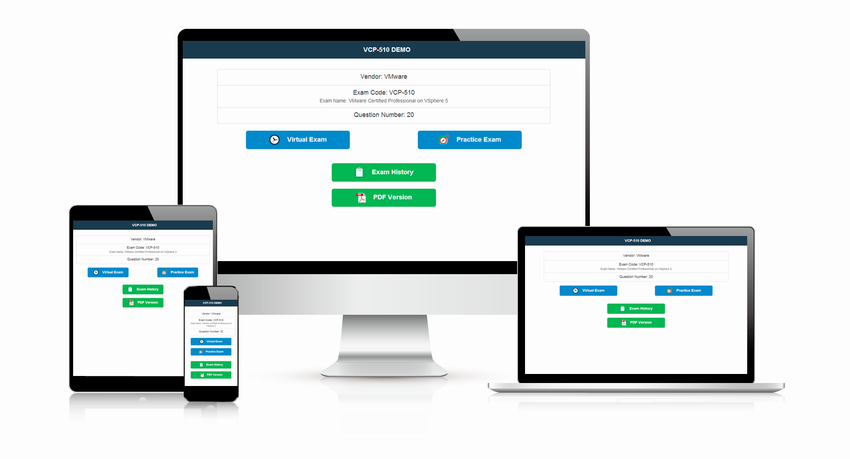
Whatever your background or study habit, the Microsoft Designing and Implementing a Data Science Solution on Azure package from Test4Cram fits: a printable PDF, a Windows desktop test engine, and an online engine that runs in any browser with nothing to install. All carry the same DP-100 practice questions.
Microsoft DP-100 Exam Overview:
| Certification Vendor: | Microsoft |
|---|---|
| Exam Name: | Designing and Implementing a Data Science Solution on Azure |
| Exam Number: | DP-100 |
| Exam Format: | Case Study, Interactive Tasks, Drag and Drop, Multiple Choice, Lab |
| Exam Duration: | 100 minutes |
| Related Certifications: | Microsoft Certified: Azure Data Scientist Associate |
| Exam Price: | $165 USD |
| Passing Score: | 700/1000 |
| Certificate Validity Period: | 1 year |
| Real Exam Qty: | 40-60 |
| Available Languages: | Spanish, Chinese (Simplified), Portuguese, French, Japanese, English, Korean, German |
| Sample Questions: |  |
| Exam Way: | Online proctored exam or test center delivery through Pearson VUE. |
| Pre Condition: | Candidates should have experience with Azure services, Python programming, and machine learning frameworks such as Scikit-Learn, PyTorch, or TensorFlow. |
| Official Syllabus URL: | https://learn.microsoft.com/en-us/credentials/certifications/exams/dp-100/ |
Microsoft DP-100 Exam Syllabus Topics:
| Section | Weight | Objectives |
|---|---|---|
| Explore data and train models | 35-40% | - Optimize model performance
|
| Design and prepare a machine learning solution | 20-25% | - Prepare development environments
|
| Deploy and retrain models | 10-15% | - Implement retraining pipelines
|
| Prepare a model for deployment | 20-25% | - Deploy machine learning models
|
Microsoft DP-100 Exam: Everything Candidates Ask
Microsoft Designing and Implementing a Data Science Solution on Azure is an official Microsoft certification exam, registered under the code DP-100. Passing it earns the Microsoft Azure certification, positioned at the Associate level. It also connects to Microsoft Certified: Azure Data Scientist Associate. Professional work increasingly demands professional proof, and this exam supplies exactly that.
The Microsoft Designing and Implementing a Data Science Solution on Azure exam contains 40-60 questions to be answered within 100 minutes. The candidates who struggle most are rarely the least knowledgeable; they are the least rehearsed at time allocation. Practice full timed sessions in the Test4Cram engine, learn to flag and move on, and the official clock becomes a familiar companion instead of a threat.
Microsoft Designing and Implementing a Data Science Solution on Azure requires 700/1000 to pass, and official registration costs $165 USD. Since a retake bills the full $165 USD again, confirming readiness first is simply good economics. Run repeated scored sessions with the Test4Cram practice tests and schedule the exam once the passing line sits comfortably below your typical result.
Candidates should have experience with Azure services, Python programming, and machine learning frameworks such as Scikit-Learn, PyTorch, or TensorFlow.
Vendor policies do change, so verify the current requirements before you register via the official exam page.
Yes. Test4Cram offers a free demo of the Microsoft Designing and Implementing a Data Science Solution on Azure questions as part of its pre-sale service, so you can evaluate quality before choosing among the three versions. After purchase, updates are free for 365 days, and when your product expires you can extend the update service at a 50% discount.
A 100% money-back guarantee protects your purchase under clear conditions. Take the Microsoft Designing and Implementing a Data Science Solution on Azure exam within 60 days of purchase; if you fail, you may claim a full refund, provided the exam matches your product. Attempts within 3 days of purchase are ineligible, as are downloaded-but-unused products, free materials, and expired orders; the candidate name must match the payer name. Submit a scanned enrollment slip and the official Score Report PDF within 2 days of the exam, and claims are processed within 7 days. You may also choose an exchange: two other exam products of equal value, free, with the update service on your original purchase kept.
Delivery is instant: files unlock for download at payment and are emailed within one minute. If nothing arrives within 2 hours, check spam and contact customer service, available 24 hours. Installation is unlimited across your computers.
Microsoft Designing and Implementing a Data Science Solution on Azure covers 4 official domains. The largest include Deploy and retrain models (10-15%), Prepare a model for deployment (20-25%), and Explore data and train models (35-40%). The full breakdown is in the topics section above; review it first and your study plan practically writes itself.
Microsoft Designing and Implementing a Data Science Solution on Azure Sample Questions:
You create an Azure Machine Learning workspace.
You plan to write an Azure Machine Learning SDK for Python v2 script that logs an image for an experiment.
The logged image must be available from the images tab in Azure Machine Learning Studio.
You need to complete the script.
Which code segments should you use? To answer, select the appropriate options in the answer area.
NOTE: Each correct selection is worth one point.
Correct Answer:

Explanation:
You use Azure Machine Learning designer to create a real-time service endpoint. You have a single Azure Machine Learning service compute resource. You train the model and prepare the real-time pipeline for deployment You need to publish the inference pipeline as a web service. Which compute type should you use?
- A. the existing Machine Learning Compute resource
- B. Azure Databricks
- C. Azure Kubernetes Services
- D. HDInsight
- E. a new Machine Learning Compute resource
Correct Answer: C 🗳️
Explanation: Only visible for Test4Cram members. You can sign-up / login (it's free).
Note: This question is part of a series of questions that present the same scenario. Each question in the series contains a unique solution that might meet the stated goals. Some question sets might have more than one correct solution, while others might not have a correct solution.
After you answer a question in this section, you will NOT be able to return to it. As a result, these questions will not appear in the review screen.
You create a model to forecast weather conditions based on historical data.
You need to create a pipeline that runs a processing script to load data from a datastore and pass the processed data to a machine learning model training script.
Solution: Run the following code:
Does the solution meet the goal?
- A. Yes
- B. No
Correct Answer: A 🗳️
Explanation: Only visible for Test4Cram members. You can sign-up / login (it's free).

For each of the following statements, select Yes if the statement is true. Otherwise, select No. NOTE: Each correct selection is worth one point.
Correct Answer:

You create an Azure Machine Learning compute target named ComputeOne by using the STANDARD_D1 virtual machine image.
You define a Python variable named was that references the Azure Machine Learning workspace. You run the following Python code:
For each of the following statements, select Yes if the statement is true. Otherwise, select No.
NOTE: Each correct selection is worth one point.
Correct Answer:

Explanation:
Box 1:Yes
ComputeTargetException class: An exception related to failures when creating, interacting with, or configuring a compute target. This exception is commonly raised for failures attaching a compute target, missing headers, and unsupported configuration values.
Create(workspace, name, provisioning_configuration)
Provision a Compute object by specifying a compute type and related configuration.
This method creates a new compute target rather than attaching an existing one.
Box 2: Yes
Box 3: No
The line before print( ' Step1 ' ) will fail.
Reference:
https://docs.microsoft.com/en-us/python/api/azureml-core/azureml.core.compute.computetarget
Viewing page 1 out of 106 pages.
Viewing questions 1-5 out of 528 questions.