

Pass ISTQB ISTQB Certified Tester Foundation Level (CTFL v4.0) Exam in First Attempt Guaranteed Updated Dump from Test4Cram!
Pass ISTQB-CTFL Exam with 409 Questions - Verified By Test4Cram
NEW QUESTION # 175
Mark the correct sentences:
* Defects are a result of environmental conditions and are also referred to as "Failures"
* A human mistake may produce a defect
* A system mil totally fail to operate correctly when a failure exists in it
* When a defect exists in a system it may result in a failure
* Defects occur only as a result of technology changes
- A. IV, V
- B. I, II
- C. II, IV
- D. II, III, IV
Answer: C
Explanation:
The question is about marking the correct sentences among the given statements related to defects, failures, and mistakes. According to the ISTQB glossary, the definitions of these terms are1:
Defect: A flaw in a component or system that can cause the component or system to fail to perform its required function, e.g. an incorrect statement or data definition. A defect, if encountered during execution, may cause a failure of the component or system.
Failure: An event in which a component or system does not perform a required function within specified limits.
Mistake: A human action that produces an incorrect result.
Therefore, out of the five given statements, only two are correct, namely:
A human mistake may produce a defect: This is true, as a mistake is a source or cause of a defect, e.g. a programmer may make a mistake in writing a code statement, which results in a defect in the software component.
When a defect exists in a system it may result in a failure: This is true, as a defect is a potential or actual cause of a failure, e.g. a defect in the software component may cause the system to fail to perform a required function when the defect is encountered during execution.
The other three statements are incorrect, namely:
Defects are a result of environmental conditions and are also referred to as "Failures": This is false, as defects are not a result of environmental conditions, but of mistakes or other factors, and defects are not the same as failures, but rather the causes of failures.
A system will totally fail to operate correctly when a failure exists in it: This is false, as a system may not necessarily fail completely or stop operating when a failure occurs, but may continue to operate with reduced functionality or performance, or with incorrect results.
Defects occur only as a result of technology changes: This is false, as defects can occur due to various reasons, not only technology changes, such as human mistakes, design flaws, requirement changes, hardware failures, etc.
Reference:
1: ISTQB Glossary of Testing Terms 4.0, 2023, available at ISTQB) and ASTQB).
NEW QUESTION # 176
What does the "absence-of-defects fallacy" refer to in software development?
- A. The idea that fixing defects is NOT important to meeting user needs.
- B. The need for constant system quality assurance and improvements.
- C. A misconception that software verification is unnecessary
- D. The belief that thoroughly testing all requirements guarantees system success.
Answer: D
NEW QUESTION # 177
A program is used to control a manufacturing line (turn machines on and off. start and stop conveyer belts, add raw materials to the flow. etc.). Not all actions are possible at all times. For example, there are certain manufacturing stages that cannot be stopped - unless there is an emergency. A tester attempts to evaluate if all such cases (where a specific action is not allowed) are covered by the tests.
Which coverage metric will provide the needed information for this analysis?
- A. Statement coverage
- B. Data flow coverage
- C. Branch Coverage
- D. Code coverage
Answer: C
Explanation:
Branch coverage is a type of structural coverage metric that measures the percentage of branches or decision outcomes that are executed by the test cases. A branch is a point in the code where the control flow can take two or more alternative paths based on a condition. For example, an if-else statement is a branch that can execute either the if-block or the else-block depending on the evaluation of the condition. Branch coverage ensures that each branch is taken at least once by the test cases, and thus reveals the behavior of the software under different scenarios. Branch coverage is also known as decision coverage or all-edges coverage.
Branch coverage is suitable for testing the cases where a specific action is not allowed, because it can verify that the test cases cover all the possible outcomes of the conditions that determine the action. For example, if the program has a condition that checks if the manufacturing stage can be stopped, then branch coverage can ensure that the test cases cover both the cases where the stage can be stopped and where it cannot be stopped.
This way, branch coverage can help identify any missing or incorrect branches that may lead to undesired or unsafe actions.
The other options are not correct because they are not suitable for testing the cases where a specific action is not allowed. Code coverage is a general term that encompasses various types of coverage metrics, such as statement coverage, branch coverage, data flow coverage, etc. Code coverage does not specify which type of coverage metric is used for the analysis. Data flow coverage is a type of structural coverage metric that measures the percentage of data flow paths that are executed by the test cases. A data flow path is a sequence of statements that define, use, or kill a variable. Data flow coverage is useful for testing the correctness and completeness of the data manipulation in the software, but not for testing the conditions that determine the actions. Statement coverage is a type of structural coverage metric that measures the percentage of statements or lines of code that are executed by the test cases. Statement coverage ensures that each statement is executed at least once by the test cases, but it does not reveal the behavior of the software under different scenarios.
Statement coverage is a weaker criterion than branch coverage, because it does not account for the branches or decision outcomes in the code. References = ISTQB Certified Tester Foundation Level (CTFL) v4.0 syllabus, Chapter 4: Test Techniques, Section 4.3: Structural Testing Techniques, Pages 51-54.
NEW QUESTION # 178
Which of the following statements best describes the difference between product risk and project risk in software testing?
- A. Product risk and project risk are essentially the same and can be used interchangeably.
- B. Product risk refers to the risk associated with the project's schedule, budget, and resources, while project risk refers to the risk associated with the quality and functionality of the software product.
- C. Product risk refers to the risk associated with issues such as delays in work product deliveries, inaccurate estimates, while project risk refers to the risk associated with the project's schedule, budget, and resources.
- D. Product risk refers to the risk associated with delays in elements such as work product deliveries and inaccurate estimates, while project risk refers to the risk associated with issues such as user dissatisfaction.
Answer: C
Explanation:
Product risk involves the potential issues that can affect the quality and functionality of the software product, such as defects, performance problems, and usability issues. Project risk, on the other hand, relates to the risks that can impact the project's schedule, budget, and resources, such as delays, cost overruns, and resource constraints. Understanding both types of risks is crucial for managing and mitigating potential problems in software projects.
References: ISTQB CTFL Syllabus, Section 5.2.1, "Risk Management in Testing."
NEW QUESTION # 179
Which of the following is NOT a typical debugging activity when a failure is triggered by dynamic testing?
- A. Fixing the cause
- B. Diagnosing the root cause
- C. Adding new test cases
- D. Reproducing the failure
Answer: C
NEW QUESTION # 180
Which of the following metrics relates to the number of defects per unit size of a work product?
- A. Average operating time until failure
- B. Number of executed test cases in relation to non-executed test cases
- C. Requirement coverage
- D. Fault density
Answer: D
NEW QUESTION # 181
Which of the types of test tools noted below BEST describes tools that support reviews?
- A. Tools to support static testing
- B. Tools to support specialized testing needs
- C. Tools to assess data quality
- D. Tools to support usability testing
Answer: A
Explanation:
Static testing refers to testing that doesn't involve executing code. It includes activities like reviews, inspections, and static analysis. Tools that support static testing help with activities such as analyzing source code, checking coding standards, and aiding in document reviews. These tools can automate or facilitate various aspects of static testing processes, such as highlighting potential issues in code or documents without executing the software.References:
* ISTQB Certified Tester Foundation Level Syllabus v4.0, Section 6.1.1.
NEW QUESTION # 182
Which ONE of the following options is NOT a benefit of test automation?
- A. Prevention of simple human errors
- B. Reduced test execution times
- C. More objective assessment
- D. Eliminating completely the need for manual testing
Answer: D
Explanation:
Comprehensive and Detailed In-Depth Explanation:
Test automation improves efficiency and accuracy, but it does NOT eliminate manual testing (D).
* (A) is correct because automation speeds up execution.
* (B) is correct as automated tests produce consistent and unbiased results.
* (C) is correct because automation reduces human errors in repetitive tests.
However, manual testing remains essential for exploratory testing, usability testing, and complex test scenarios.
Reference: ISTQB CTFL v4.0 Syllabus, Section 6.2 - Test Automation Benefits and Risks
NEW QUESTION # 183
Which of the following is the BEST reason for selecting a particular type of software development lifecycle model?
- A. The type of product being developed
- B. The project manager's preference
- C. The project team's overall familiarity with the model
- D. Tester skill level with the software development lifecycle model
Answer: A
Explanation:
The choice of a software development lifecycle (SDLC) model is primarily influenced by the type of product being developed. Different products and project requirements may demand different SDLC models to address specific challenges and needs efficiently. For instance, a complex, safety-critical product might best be served by a Waterfall model due to its structured nature and phase dependencies, while a more iterative and incremental model might be suited for projects requiring frequent feedback and changes.
Reference:
ISTQB Certified Tester Foundation Level Syllabus v4.0, Section 2.1 "Software Development Lifecycles".
NEW QUESTION # 184
An Incident Management tool implements the following defect states; Open, Assigned, Solved, Closed Consider the following defect report:
Id T000561
Test Object "Warehouse Management' application
Tester name; John Bishop
Date: 10th. April 2010
Test Case MRT558I
Status OPEN
Severity Serious
Priority
Problem- After inputting the Total Quantity item = 450 in the SV034 screen, the system shows an unexpected Error message=47 Correction:
Developer name:
Closing date:
Which of the following is a valid criticism of this report?
- A. There is no link to the applicable requirement (traceability)
- B. The version of the application is missing
- C. The Priority, the Correction description and the Developer name are missing
- D. The description is not highlighting the source of the problem
Answer: B
Explanation:
A valid criticism of this report is that the version of the application is missing. The version of the application is an important piece of information that should be included in a defect report, as it helps to identify which release or build of the software product contains the defect. The version of the application can also help to reproduce and debug the defect, as different versions may have different behaviors or features. The other options are not valid criticisms of this report. The priority, the correction description and the developer name are not missing, but rather not applicable for this report. The priority is a measure of how urgently a defect needs to be fixed, which can be assigned by the project manager or the defect tracking system, not by the tester who reports the defect. The correction description and the developer name are information that are added after the defect has been resolved, not when it has been reported. There is no link to the applicable requirement (traceability) is not a valid criticism of this report, because traceability is not a mandatory attribute of a defect report, but rather an optional one. Traceability is a relationship between two or more entities (such as requirements, test cases, defects, etc.) that shows how they are related or dependent on each other. Traceability can help to verify that the requirements are met by the test cases and defects, but it is not essential for reporting a defect. The description is not highlighting the source of the problem is not a valid criticism of this report, because highlighting the source of the problem is not a responsibility of the tester who reports the defect, but rather of the developer who fixes the defect. The description should provide enough information to describe what happened when the defect occurred, such as input values, expected results, actual results, error messages, screenshots, etc., but it does not need to explain why or how it happened.
Verified References: A Study Guide to the ISTQB Foundation Level 2018 Syllabus - Springer, page 140.
NEW QUESTION # 185
A mid-size software product development company has analyzed data related to defects detected in its product and found out that detects fixed in earlier builds are getting re-opened after a few months.
The company management now seeks your advice in order to reverse this trend and prevent re-opening of defects fixed earlier.
What would be your FIRST recommendation to the company?
- A. If required, tram the teams responsible for development and testing of the modules containing maximum number of defects, and if this does not help, replace them with more knowledgeable people
- B. Automate existing test suits so that lesser time is spent on execution of each test, and more tests can be executed m the available time thus leading to a lower probability of defects slipping by
- C. Verify existing regression test suite are adequate, and augment it, if required, in order to ensure that defects fixed earlier get re-tested in each subsequent build
- D. Analyze the product modules containing maximum defects, and get them thoroughly tested and defects fixed as a one-time activity
Answer: C
Explanation:
Regression testing is a type of testing that verifies that previously tested software still performs correctly after changes. Regression testing can help prevent re-opening of defects fixed earlier by ensuring that they do not cause any new failures or side effects. The first recommendation to the company is to verify existing regression test suite are adequate, and augment it, if required, in order to ensure that defects fixed earlier get re-tested in each subsequent build. This can help improve the coverage and effectiveness of regression testing and detect any regression defects as soon as possible. Automating existing test suites may also help reduce the time and effort required for regression testing, but this is not the first recommendation, as automation may not be feasible or cost-effective for all test cases. Analyzing the product modules containing maximum defects and getting them thoroughly tested and defects fixed as a one-time activity may also help reduce the defect density and improve the quality of those modules, but this is not the first recommendation, as it does not address the root cause of re-opening defects fixed earlier. Training or replacing the teams responsible for development and testing of the modules containing maximum number of defects may also help improve their skills or performance, but this is not the first recommendation, as it may not be necessary or appropriate for all teams. Verified References: [A Study Guide to the ISTQB Foundation Level 2018 Syllabus - Springer], Chapter 2, page 19; Chapter 4, page 45.
NEW QUESTION # 186
Which of the following types of bugs are more likely to be found by static testing then by dynamic testing?
- A. A sub-system that does not perform the intended functionality
- B. Functions that take much longer time to complete than expected
- C. Crashes of the application
- D. Variables that were declared in the code without initialization
Answer: D
NEW QUESTION # 187
A team's test strategy was to invest equal effort in testing each of a system's modules. After running one test cycle, it turned out that most of the critical bugs were detected in one of the system's modules.
Which testing principal suggests a change to the current test strategy for the next test cycle?
- A. Defect clustering
- B. Early testing
- C. Pesticide Paradox
- D. Absence-of-errors fallacy
Answer: A
Explanation:
Defect clustering is a testing principle that states that a small number of modules contain most of the defects detected during pre-release testing, or are responsible for most of the operational failures. Defect clustering can be explained by Pareto's principle (also known as the 80-20 rule), which states that approximately 80% of the problems are found in 20% of the modules. Defect clustering suggests a change to the current test strategy for the next test cycle, as it implies that more effort should be allocated to test the modules that have shown high defect density or criticality. Pesticide paradox is another testing principle that states that if the same tests are repeated over and over again, eventually they will no longer find any new defects. Pesticide paradox suggests a change to the current test strategy for the next test cycle, but not based on defect clustering, but rather on test diversity and coverage. Early testing is a testing principle that states that testing activities should start as early as possible in the software development life cycle and should be focused on defined objectives. Early testing does not suggest a change to the current test strategy for the next test cycle, but rather a proactive approach to prevent defects from occurring or propagating. Absence-of-errors fallacy is a testing principle that states that finding and fixing defects does not help if the system built is unusable and does not fulfill the users' needs and expectations. Absence-of-errors fallacy does not suggest a change to the current test strategy for the next test cycle, but rather a focus on quality attributes and user requirements. Verified Reference: A Study Guide to the ISTQB Foundation Level 2018 Syllabus - Springer, Chapter 1, page 9-10.
NEW QUESTION # 188
Which of the following statements BEST describes the shift-left approach in software testing?
- A. Testing is performed by an independent testing team.
- B. Testing is performed as early as possible in the software development life cycle.
- C. Testing is performed after the development phase is completed.
- D. Testing is performed on the entire system or product.
Answer: B
NEW QUESTION # 189
The following chart represents metrics related to testing of a project that was competed. Indicate what is represented by tie lines A, B and the axes X.Y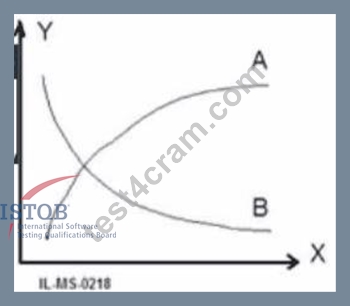
A)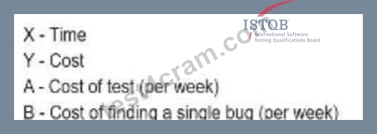
B)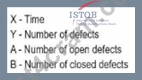
C)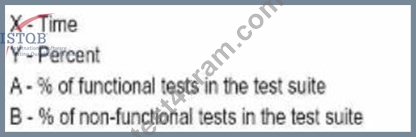
D)
- A. Option B
- B. Option C
- C. Option D
- D. Option A
Answer: C
Explanation:
Option D correctly explains what is represented by the lines A, B and the axes X, Y in a testing metrics chart.
According to option D:
* X-axis represents Time
* Y-axis represents Count
* Line A represents Number of open bugs
* Line B represents Total number of executed tests
This information is essential in understanding and analyzing the testing metrics of a completed project.
ISTQB Certified Tester Foundation Level (CTFL) v4.0 Syllabus, Section 2.5.1, Page 35.
NEW QUESTION # 190
Which sequence of state transition stated in the answer choices is correct in accordance with the following figure depicting me life-cycle of a defect?
- A. S0->S1->S2->S3->S5->S3->S4
- B. S0->S1->S2->S3->S5^>S1
- C. S0->S1->S2->S3->S4
- D. S0->S1->S2->S3->S5->S1->S2->S3
Answer: D
Explanation:
The figure depicts the life-cycle of a defect using state transition testing. State transition testing is a technique that models how a system transitions from one state to another depending on events or conditions. The figure shows six states (S0 to S5) and seven transitions (T0 to T6). The correct sequence of state transitions that follows the figure is S0->S1->S2->S3->S5->S1->S2->S3. This sequence represents the following scenario:
* S0: The defect is not yet detected (initial state).
* T0: The defect is detected by testing (event).
* S1: The defect is reported and registered (state).
* T1: The defect is assigned to a developer for fixing (event).
* S2: The defect is being fixed by the developer (state).
* T2: The developer fixes the defect and delivers a new version (event).
* S3: The defect is verified by testing (state).
* T5: The testing fails to confirm that the defect is fixed (event).
* S5: The defect is rejected by testing (state).
* T6: The defect is reassigned to a developer for fixing (event).
* S1: The defect is reported and registered (state).
* T1: The defect is assigned to a developer for fixing (event).
* S2: The defect is being fixed by the developer (state).
* T2: The developer fixes the defect and delivers a new version (event).
* S3: The defect is verified by testing (state). The other sequences are incorrect, as they do not follow the transitions shown in the figure. Verified References: [A Study Guide to the ISTQB Foundation Level
2018 Syllabus - Springer], Chapter 4, page 40-41.
NEW QUESTION # 191
Which of the following definitions is NOT true?
- A. Test Management tools monitor and report on how a system behaves during the testing activities.
- B. Test data preparation tools fill databases, create files or data transmissions to set up test data to be used during the execution of tests.
- C. Test comparators determine differences between files, databases or test results.
- D. Test execution tools execute test objects using automated test scripts.
Answer: A
Explanation:
Test Management tools are designed to support the planning, execution, and monitoring of the testing process. They provide features for managing test cases, test runs, tracking defects, and reporting on testing activities. However, the statement in option C describes Test Management tools as monitoring and reporting on the system's behavior during testing activities, which is not accurate. Test Management tools focus on the testing process itself rather than on the behavior of the system under test.
Test data preparation tools (A) indeed create and manage test data for use during test execution.
Test execution tools (B) automate the execution of test cases and the comparison of actual outcomes against expected results.
Test comparators (D) are tools that compare actual outcomes with expected outcomes, highlighting discrepancies.
Therefore, option C is the correct answer as it inaccurately describes the function of Test Management tools.
NEW QUESTION # 192
In maintenance testing, what is the relationship between impact analysis and regression testing?
- A. The impact analysis is used to evaluate the amount of regression testing to be performed.
- B. Impact analysis requires a regression testing for all program elements which were newly integrated (new functionalities).
- C. Impact analysis requires a regression testing for only the tests that have detected faults in previous SW release
- D. There is no relationship between impact analysis and regression testing.
Answer: A
Explanation:
In maintenance testing, the relationship between impact analysis and regression testing is that the impact analysis is used to evaluate the amount of regression testing to be performed. Maintenance testing is a type of testing that is performed on an existing software product after it has been delivered or deployed, in order to ensure that it still meets its requirements and functions correctly after a change or a modification.
Maintenance testing can be triggered by various reasons, such as corrective maintenance (fixing defects), adaptive maintenance (adapting to new environments), perfective maintenance (improving performance), preventive maintenance (avoiding future problems), etc. Impact analysis is a technique that is used to assess the extent and nature of changes introduced by maintenance activities on the software product or project.
Impact analysis helps to identify which parts of the software product are affected by the changes, which parts need to be modified or updated accordingly, which parts need to be retested or verified for correctness or compatibility, etc. Regression testing is a type of testing that verifies that previously tested software still performs correctly after a change or a modification. Regression testing helps to detect any side effects or unintended consequences of maintenance activities on the software product's functionality or quality.
Regression testing can be performed at various levels and scopes depending on the impact analysis results.
Therefore, in maintenance testing, impact analysis is used to evaluate the amount of regression testing to be performed. Verified References: A Study Guide to the ISTQB Foundation Level 2018 Syllabus - Springer, page 20.
NEW QUESTION # 193
Which of the following statements is true?
- A. Testers who perform functional tests are generally expected to have more technical skills than testers who perform non-functional tests
- B. Functional testing focuses on what the system should do while non-functional testing on the internal structure of the system
- C. The test techniques that can be used to design white-box tests are described in the ISO/IEC 25010 standard
- D. Non-functional testing includes testing of both technical and non-technical quality characteristics
Answer: D
Explanation:
Non-functional testing includes testing of both technical and non-technical quality characteristics. Non- functional testing is the process of testing the quality attributes of a system, such as performance, usability, security, reliability, etc. Non-functional testing can be applied at any test level and can use both black-box and white-box test techniques. Non-functional testing can cover both technical aspects, such as response time, throughput, resource consumption, etc., and non-technical aspects, such as user satisfaction, accessibility, compliance, etc. Therefore, option B is the correct answer.
References: ISTQB® Certified Tester Foundation Level Syllabus v4.01, Section 1.3.1, page 13; ISTQB® Glossary v4.02, page 40.
NEW QUESTION # 194
......
Penetration testers simulate ISTQB-CTFL exam: https://www.test4cram.com/ISTQB-CTFL_real-exam-dumps.html
Free Test Engine For ISTQB Certified Tester Foundation Level (CTFL v4.0) Certification Exams: https://drive.google.com/open?id=1lxhnOT8VlAdef0PPOzDLH0RLAWT_LZ6v