

49 Q&As in UPDATED CKS Exam Questions Certification Test Engine to PDF
Get The Important Preparation Guide With CKS Dumps
NEW QUESTION 22
Fix all issues via configuration and restart the affected components to ensure the new setting takes effect.
Fix all of the following violations that were found against the API server:- a. Ensure that the RotateKubeletServerCertificate argument is set to true.
b. Ensure that the admission control plugin PodSecurityPolicy is set.
c. Ensure that the --kubelet-certificate-authority argument is set as appropriate.
Fix all of the following violations that were found against the Kubelet:- a. Ensure the --anonymous-auth argument is set to false.
b. Ensure that the --authorization-mode argument is set to Webhook.
Fix all of the following violations that were found against the ETCD:-
a. Ensure that the --auto-tls argument is not set to true
b. Ensure that the --peer-auto-tls argument is not set to true
Hint: Take the use of Tool Kube-Bench
Answer:
Explanation:
Fix all of the following violations that were found against the API server:- a. Ensure that the RotateKubeletServerCertificate argument is set to true.
apiVersion: v1
kind: Pod
metadata:
creationTimestamp: null
labels:
component: kubelet
tier: control-plane
name: kubelet
namespace: kube-system
spec:
containers:
- command:
- kube-controller-manager
+ - --feature-gates=RotateKubeletServerCertificate=true
image: gcr.io/google_containers/kubelet-amd64:v1.6.0
livenessProbe:
failureThreshold: 8
httpGet:
host: 127.0.0.1
path: /healthz
port: 6443
scheme: HTTPS
initialDelaySeconds: 15
timeoutSeconds: 15
name: kubelet
resources:
requests:
cpu: 250m
volumeMounts:
- mountPath: /etc/kubernetes/
name: k8s
readOnly: true
- mountPath: /etc/ssl/certs
name: certs
- mountPath: /etc/pki
name: pki
hostNetwork: true
volumes:
- hostPath:
path: /etc/kubernetes
name: k8s
- hostPath:
path: /etc/ssl/certs
name: certs
- hostPath:
path: /etc/pki
name: pki
b. Ensure that the admission control plugin PodSecurityPolicy is set.
audit: "/bin/ps -ef | grep $apiserverbin | grep -v grep"
tests:
test_items:
- flag: "--enable-admission-plugins"
compare:
op: has
value: "PodSecurityPolicy"
set: true
remediation: |
Follow the documentation and create Pod Security Policy objects as per your environment.
Then, edit the API server pod specification file $apiserverconf
on the master node and set the --enable-admission-plugins parameter to a value that includes PodSecurityPolicy :
--enable-admission-plugins=...,PodSecurityPolicy,...
Then restart the API Server.
scored: true
c. Ensure that the --kubelet-certificate-authority argument is set as appropriate.
audit: "/bin/ps -ef | grep $apiserverbin | grep -v grep"
tests:
test_items:
- flag: "--kubelet-certificate-authority"
set: true
remediation: |
Follow the Kubernetes documentation and setup the TLS connection between the apiserver and kubelets. Then, edit the API server pod specification file
$apiserverconf on the master node and set the --kubelet-certificate-authority parameter to the path to the cert file for the certificate authority.
--kubelet-certificate-authority=<ca-string>
scored: true
Fix all of the following violations that were found against the ETCD:-
a. Ensure that the --auto-tls argument is not set to true
Edit the etcd pod specification file $etcdconf on the master node and either remove the --auto-tls parameter or set it to false. --auto-tls=false b. Ensure that the --peer-auto-tls argument is not set to true Edit the etcd pod specification file $etcdconf on the master node and either remove the --peer-auto-tls parameter or set it to false. --peer-auto-tls=false
NEW QUESTION 23
You must complete this task on the following cluster/nodes: Cluster: immutable-cluster Master node: master1 Worker node: worker1 You can switch the cluster/configuration context using the following command:
[desk@cli] $ kubectl config use-context immutable-cluster
Context: It is best practice to design containers to be stateless and immutable.
Task:
Inspect Pods running in namespace prod and delete any Pod that is either not stateless or not immutable.
Use the following strict interpretation of stateless and immutable:
1. Pods being able to store data inside containers must be treated as not stateless.
Note: You don't have to worry whether data is actually stored inside containers or not already.
2. Pods being configured to be privileged in any way must be treated as potentially not stateless or not immutable.
Answer:
Explanation:
k get pods -n prod
k get pod <pod-name> -n prod -o yaml | grep -E 'privileged|ReadOnlyRootFileSystem' Delete the pods which do have any of these 2 properties privileged:true or ReadOnlyRootFileSystem: false
[desk@cli]$ k get pods -n prod
NAME READY STATUS RESTARTS AGE
cms 1/1 Running 0 68m
db 1/1 Running 0 4m
nginx 1/1 Running 0 23m
[desk@cli]$ k get pod nginx -n prod -o yaml | grep -E 'privileged|RootFileSystem'
{"apiVersion":"v1","kind":"Pod","metadata":{"annotations":{},"creationTimestamp":null,"labels":{"run":"nginx"},"name":"nginx","namespace":"prod"},"spec":{"containers":[{"image":"nginx","name":"nginx","resources":{},"securityContext":{"privileged":true}}],"dnsPolicy":"ClusterFirst","restartPolicy":"Always"},"status":{}} f:privileged: {} privileged: true
[desk@cli]$ k delete pod nginx -n prod
[desk@cli]$ k get pod db -n prod -o yaml | grep -E 'privileged|RootFilesystem'
[desk@cli]$ k delete pod cms -n prod Reference: https://kubernetes.io/docs/concepts/policy/pod-security-policy/ https://cloud.google.com/architecture/best-practices-for-operating-containers Reference:
[desk@cli]$ k delete pod cms -n prod Reference: https://kubernetes.io/docs/concepts/policy/pod-security-policy/ https://cloud.google.com/architecture/best-practices-for-operating-containers
NEW QUESTION 24
Create a PSP that will only allow the persistentvolumeclaim as the volume type in the namespace restricted.
Create a new PodSecurityPolicy named prevent-volume-policy which prevents the pods which is having different volumes mount apart from persistentvolumeclaim.
Create a new ServiceAccount named psp-sa in the namespace restricted.
Create a new ClusterRole named psp-role, which uses the newly created Pod Security Policy prevent-volume-policy Create a new ClusterRoleBinding named psp-role-binding, which binds the created ClusterRole psp-role to the created SA psp-sa.
Hint:
Also, Check the Configuration is working or not by trying to Mount a Secret in the pod maifest, it should get failed.
POD Manifest:
apiVersion: v1
kind: Pod
metadata:
name:
spec:
containers:
- name:
image:
volumeMounts:
- name:
mountPath:
volumes:
- name:
secret:
secretname:
Answer:
Explanation:
apiVersion: policy/v1beta1
kind: PodSecurityPolicy
metadata:
name: restricted
annotations:
seccomp.security.alpha.kubernetes.io/allowedProfileNames: 'docker/default,runtime/default' apparmor.security.beta.kubernetes.io/allowedProfileNames: 'runtime/default' seccomp.security.alpha.kubernetes.io/defaultProfileName: 'runtime/default' apparmor.security.beta.kubernetes.io/defaultProfileName: 'runtime/default' spec:
privileged: false
# Required to prevent escalations to root.
allowPrivilegeEscalation: false
# This is redundant with non-root + disallow privilege escalation,
# but we can provide it for defense in depth.
requiredDropCapabilities:
- ALL
# Allow core volume types.
volumes:
- 'configMap'
- 'emptyDir'
- 'projected'
- 'secret'
- 'downwardAPI'
# Assume that persistentVolumes set up by the cluster admin are safe to use.
- 'persistentVolumeClaim'
hostNetwork: false
hostIPC: false
hostPID: false
runAsUser:
# Require the container to run without root privileges.
rule: 'MustRunAsNonRoot'
seLinux:
# This policy assumes the nodes are using AppArmor rather than SELinux.
rule: 'RunAsAny'
supplementalGroups:
rule: 'MustRunAs'
ranges:
# Forbid adding the root group.
- min: 1
max: 65535
fsGroup:
rule: 'MustRunAs'
ranges:
# Forbid adding the root group.
- min: 1
max: 65535
readOnlyRootFilesystem: false
NEW QUESTION 25
Create a Pod name Nginx-pod inside the namespace testing, Create a service for the Nginx-pod named nginx-svc, using the ingress of your choice, run the ingress on tls, secure port.
Answer:
Explanation:
$ kubectl get ing -n <namespace-of-ingress-resource>
NAME HOSTS ADDRESS PORTS AGE
cafe-ingress cafe.com 10.0.2.15 80 25s
$ kubectl describe ing <ingress-resource-name> -n <namespace-of-ingress-resource> Name: cafe-ingress Namespace: default Address: 10.0.2.15 Default backend: default-http-backend:80 (172.17.0.5:8080) Rules:
Host Path Backends
---- ---- --------
cafe.com
/tea tea-svc:80 (<none>)
/coffee coffee-svc:80 (<none>)
Annotations:
kubectl.kubernetes.io/last-applied-configuration: {"apiVersion":"networking.k8s.io/v1","kind":"Ingress","metadata":{"annotations":{},"name":"cafe-ingress","namespace":"default","selfLink":"/apis/networking/v1/namespaces/default/ingresses/cafe-ingress"},"spec":{"rules":[{"host":"cafe.com","http":{"paths":[{"backend":{"serviceName":"tea-svc","servicePort":80},"path":"/tea"},{"backend":{"serviceName":"coffee-svc","servicePort":80},"path":"/coffee"}]}}]},"status":{"loadBalancer":{"ingress":[{"ip":"169.48.142.110"}]}}} Events:
Type Reason Age From Message
---- ------ ---- ---- -------
Normal CREATE 1m ingress-nginx-controller Ingress default/cafe-ingress
Normal UPDATE 58s ingress-nginx-controller Ingress default/cafe-ingress
$ kubectl get pods -n <namespace-of-ingress-controller>
NAME READY STATUS RESTARTS AGE
ingress-nginx-controller-67956bf89d-fv58j 1/1 Running 0 1m
$ kubectl logs -n <namespace> ingress-nginx-controller-67956bf89d-fv58j
------------------------------------------------------------------------------- NGINX Ingress controller Release: 0.14.0 Build: git-734361d Repository: https://github.com/kubernetes/ingress-nginx
-------------------------------------------------------------------------------
....
NEW QUESTION 26
Analyze and edit the given Dockerfile
FROM ubuntu:latest
RUN apt-get update -y
RUN apt-install nginx -y
COPY entrypoint.sh /
ENTRYPOINT ["/entrypoint.sh"]
USER ROOT
Fixing two instructions present in the file being prominent security best practice issues Analyze and edit the deployment manifest file apiVersion: v1 kind: Pod metadata:
name: security-context-demo-2
spec:
securityContext:
runAsUser: 1000
containers:
- name: sec-ctx-demo-2
image: gcr.io/google-samples/node-hello:1.0
securityContext:
runAsUser: 0
privileged: True
allowPrivilegeEscalation: false
Fixing two fields present in the file being prominent security best practice issues Don't add or remove configuration settings; only modify the existing configuration settings Whenever you need an unprivileged user for any of the tasks, use user test-user with the user id 5487
- A. Send us your Feedback on this.
Answer: A
NEW QUESTION 27
SIMULATION
a. Retrieve the content of the existing secret named default-token-xxxxx in the testing namespace.
Store the value of the token in the token.txt
b. Create a new secret named test-db-secret in the DB namespace with the following content:
username: mysql
password: password@123
Create the Pod name test-db-pod of image nginx in the namespace db that can access test-db-secret via a volume at path /etc/mysql-credentials
Answer:
Explanation:
To add a Kubernetes cluster to your project, group, or instance:
Navigate to your:
Project's Operations > Kubernetes page, for a project-level cluster.
Group's Kubernetes page, for a group-level cluster.
Admin Area > Kubernetes page, for an instance-level cluster.
Click Add Kubernetes cluster.
Click the Add existing cluster tab and fill in the details:
Kubernetes cluster name (required) - The name you wish to give the cluster.
Environment scope (required) - The associated environment to this cluster.
API URL (required) - It's the URL that GitLab uses to access the Kubernetes API. Kubernetes exposes several APIs, we want the "base" URL that is common to all of them. For example, https://kubernetes.example.com rather than https://kubernetes.example.com/api/v1.
Get the API URL by running this command:
kubectl cluster-info | grep -E 'Kubernetes master|Kubernetes control plane' | awk '/http/ {print $NF}' CA certificate (required) - A valid Kubernetes certificate is needed to authenticate to the cluster. We use the certificate created by default.
List the secrets with kubectl get secrets, and one should be named similar to default-token-xxxxx. Copy that token name for use below.
Get the certificate by running this command:
kubectl get secret <secret name> -o jsonpath="{['data']['ca\.crt']}"
NEW QUESTION 28
Cluster: admission-cluster
Master node: master
Worker node: worker1
You can switch the cluster/configuration context using the following command:
[desk@cli] $ kubectl config use-context admission-cluster
Context:
A container image scanner is set up on the cluster, but it's not yet fully integrated into the cluster's configuration. When complete, the container image scanner shall scan for and reject the use of vulnerable images.
Task:
You have to complete the entire task on the cluster's master node, where all services and files have been prepared and placed.
Given an incomplete configuration in directory /etc/Kubernetes/config and a functional container image scanner with HTTPS endpoint https://imagescanner.local:8181/image_policy:
1. Enable the necessary plugins to create an image policy
2. Validate the control configuration and change it to an implicit deny
3. Edit the configuration to point to the provided HTTPS endpoint correctly Finally, test if the configuration is working by trying to deploy the vulnerable resource /home/cert_masters/test-pod.yml Note: You can find the container image scanner's log file at /var/log/policy/scanner.log
Answer:
Explanation:
[master@cli] $ cd /etc/Kubernetes/config
1. Edit kubeconfig to explicity deny
[master@cli] $ vim kubeconfig.json
"defaultAllow": false # Change to false
2. fix server parameter by taking its value from ~/.kube/config
[master@cli] $cat /etc/kubernetes/config/kubeconfig.yaml | grep server
server:
3. Enable ImagePolicyWebhook
[master@cli] $ vim /etc/kubernetes/manifests/kube-apiserver.yaml
- --enable-admission-plugins=NodeRestriction,ImagePolicyWebhook # Add this
- --admission-control-config-file=/etc/kubernetes/config/kubeconfig.json # Add this Explanation
[desk@cli] $ ssh master
[master@cli] $ cd /etc/Kubernetes/config
[master@cli] $ vim kubeconfig.json
{
"imagePolicy": {
"kubeConfigFile": "/etc/kubernetes/config/kubeconfig.yaml",
"allowTTL": 50,
"denyTTL": 50,
"retryBackoff": 500,
"defaultAllow": true # Delete this
"defaultAllow": false # Add this
}
}
Note: We can see a missing value here, so how from where i can get this value
[master@cli] $cat ~/.kube/config | grep server
or
[master@cli] $cat /etc/kubernetes/manifests/kube-apiserver.yaml
[master@cli] $vim /etc/kubernetes/config/kubeconfig.yaml
[master@cli] $ vim /etc/kubernetes/manifests/kube-apiserver.yaml - --enable-admission-plugins=NodeRestriction # Delete This - --enable-admission-plugins=NodeRestriction,ImagePolicyWebhook # Add this - --admission-control-config-file=/etc/kubernetes/config/kubeconfig.json # Add this Reference: https://kubernetes.io/docs/reference/access-authn-authz/admission-controllers/
- --enable-admission-plugins=NodeRestriction # Delete This
- --enable-admission-plugins=NodeRestriction,ImagePolicyWebhook # Add this
- --admission-control-config-file=/etc/kubernetes/config/kubeconfig.json # Add this
[master@cli] $ vim /etc/kubernetes/manifests/kube-apiserver.yaml - --enable-admission-plugins=NodeRestriction # Delete This - --enable-admission-plugins=NodeRestriction,ImagePolicyWebhook # Add this - --admission-control-config-file=/etc/kubernetes/config/kubeconfig.json # Add this Reference: https://kubernetes.io/docs/reference/access-authn-authz/admission-controllers/
NEW QUESTION 29
SIMULATION
Create a RuntimeClass named untrusted using the prepared runtime handler named runsc.
Create a Pods of image alpine:3.13.2 in the Namespace default to run on the gVisor runtime class.
Verify: Exec the pods and run the dmesg, you will see output like this:-
- A. Send us your feedback on it.
Answer: A
NEW QUESTION 30
You can switch the cluster/configuration context using the following command: [desk@cli] $ kubectl config use-context qa Context: A pod fails to run because of an incorrectly specified ServiceAccount Task: Create a new service account named backend-qa in an existing namespace qa, which must not have access to any secret. Edit the frontend pod yaml to use backend-qa service account Note: You can find the frontend pod yaml at /home/cert_masters/frontend-pod.yaml
Answer:
Explanation:
[desk@cli] $ k create sa backend-qa -n qa sa/backend-qa created [desk@cli] $ k get role,rolebinding -n qa No resources found in qa namespace. [desk@cli] $ k create role backend -n qa --resource pods,namespaces,configmaps --verb list # No access to secret [desk@cli] $ k create rolebinding backend -n qa --role backend --serviceaccount qa:backend-qa [desk@cli] $ vim /home/cert_masters/frontend-pod.yaml apiVersion: v1 kind: Pod metadata:
name: frontend
spec:
serviceAccountName: backend-qa # Add this
image: nginx
name: frontend
[desk@cli] $ k apply -f /home/cert_masters/frontend-pod.yaml pod created
[desk@cli] $ k create sa backend-qa -n qa serviceaccount/backend-qa created [desk@cli] $ k get role,rolebinding -n qa No resources found in qa namespace. [desk@cli] $ k create role backend -n qa --resource pods,namespaces,configmaps --verb list role.rbac.authorization.k8s.io/backend created [desk@cli] $ k create rolebinding backend -n qa --role backend --serviceaccount qa:backend-qa rolebinding.rbac.authorization.k8s.io/backend created [desk@cli] $ vim /home/cert_masters/frontend-pod.yaml apiVersion: v1 kind: Pod metadata:
name: frontend
spec:
serviceAccountName: backend-qa # Add this
image: nginx
name: frontend
[desk@cli] $ k apply -f /home/cert_masters/frontend-pod.yaml pod/frontend created https://kubernetes.io/docs/tasks/configure-pod-container/configure-service-account/
NEW QUESTION 31
Context
A PodSecurityPolicy shall prevent the creation of privileged Pods in a specific namespace.
Task
Create a new PodSecurityPolicy named prevent-psp-policy,which prevents the creation of privileged Pods.
Create a new ClusterRole named restrict-access-role, which uses the newly created PodSecurityPolicy prevent-psp-policy.
Create a new ServiceAccount named psp-restrict-sa in the existing namespace staging.
Finally, create a new ClusterRoleBinding named restrict-access-bind, which binds the newly created ClusterRole restrict-access-role to the newly created ServiceAccount psp-restrict-sa.
Answer:
Explanation:


NEW QUESTION 32
Use the kubesec docker images to scan the given YAML manifest, edit and apply the advised changes, and passed with a score of 4 points.
kubesec-test.yaml
apiVersion: v1
kind: Pod
metadata:
name: kubesec-demo
spec:
containers:
- name: kubesec-demo
image: gcr.io/google-samples/node-hello:1.0
securityContext:
readOnlyRootFilesystem: true
Hint: docker run -i kubesec/kubesec:512c5e0 scan /dev/stdin < kubesec-test.yaml
Answer:
Explanation:
kubesec scan k8s-deployment.yaml
cat <<EOF > kubesec-test.yaml
apiVersion: v1
kind: Pod
metadata:
name: kubesec-demo
spec:
containers:
- name: kubesec-demo
image: gcr.io/google-samples/node-hello:1.0
securityContext:
readOnlyRootFilesystem: true
EOF
kubesec scan kubesec-test.yaml
docker run -i kubesec/kubesec:512c5e0 scan /dev/stdin < kubesec-test.yaml kubesec http 8080 &
[1] 12345
{"severity":"info","timestamp":"2019-05-12T11:58:34.662+0100","caller":"server/server.go:69","message":"Starting HTTP server on port 8080"} curl -sSX POST --data-binary @test/asset/score-0-cap-sys-admin.yml http://localhost:8080/scan
[
{
"object": "Pod/security-context-demo.default",
"valid": true,
"message": "Failed with a score of -30 points",
"score": -30,
"scoring": {
"critical": [
{
"selector": "containers[] .securityContext .capabilities .add == SYS_ADMIN",
"reason": "CAP_SYS_ADMIN is the most privileged capability and should always be avoided"
},
{
"selector": "containers[] .securityContext .runAsNonRoot == true",
"reason": "Force the running image to run as a non-root user to ensure least privilege"
},
// ...
NEW QUESTION 33
You must complete this task on the following cluster/nodes:
Cluster: trace
Master node: master
Worker node: worker1
You can switch the cluster/configuration context using the following command:
[desk@cli] $ kubectl config use-context trace
Given: You may use Sysdig or Falco documentation.
Task:
Use detection tools to detect anomalies like processes spawning and executing something weird frequently in the single container belonging to Pod tomcat.
Two tools are available to use:
1. falco
2. sysdig
Tools are pre-installed on the worker1 node only.
Analyse the container's behaviour for at least 40 seconds, using filters that detect newly spawning and executing processes.
Store an incident file at /home/cert_masters/report, in the following format:
[timestamp],[uid],[processName]
Note: Make sure to store incident file on the cluster's worker node, don't move it to master node.
Answer:
Explanation:
$vim /etc/falco/falco_rules.local.yaml
- rule: Container Drift Detected (open+create)
desc: New executable created in a container due to open+create
condition: >
evt.type in (open,openat,creat) and
evt.is_open_exec=true and
container and
not runc_writing_exec_fifo and
not runc_writing_var_lib_docker and
not user_known_container_drift_activities and
evt.rawres>=0
output: >
%evt.time,%user.uid,%proc.name # Add this/Refer falco documentation
priority: ERROR
$kill -1 <PID of falco>
Explanation
[desk@cli] $ ssh node01
[node01@cli] $ vim /etc/falco/falco_rules.yaml
search for Container Drift Detected & paste in falco_rules.local.yaml
[node01@cli] $ vim /etc/falco/falco_rules.local.yaml
- rule: Container Drift Detected (open+create)
desc: New executable created in a container due to open+create
condition: >
evt.type in (open,openat,creat) and
evt.is_open_exec=true and
container and
not runc_writing_exec_fifo and
not runc_writing_var_lib_docker and
not user_known_container_drift_activities and
evt.rawres>=0
output: >
%evt.time,%user.uid,%proc.name # Add this/Refer falco documentation
priority: ERROR
[node01@cli] $ vim /etc/falco/falco.yaml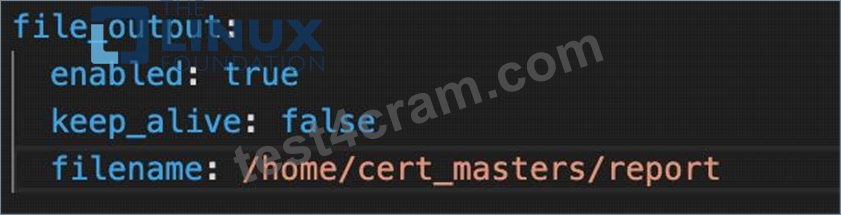
NEW QUESTION 34
SIMULATION
Create a Pod name Nginx-pod inside the namespace testing, Create a service for the Nginx-pod named nginx-svc, using the ingress of your choice, run the ingress on tls, secure port.
- A. Sendusyourfeedbackonit
Answer: A
NEW QUESTION 35
You can switch the cluster/configuration context using the following command:
[desk@cli] $ kubectl config use-context dev
A default-deny NetworkPolicy avoid to accidentally expose a Pod in a namespace that doesn't have any other NetworkPolicy defined.
Task: Create a new default-deny NetworkPolicy named deny-network in the namespace test for all traffic of type Ingress + Egress The new NetworkPolicy must deny all Ingress + Egress traffic in the namespace test.
Apply the newly created default-deny NetworkPolicy to all Pods running in namespace test.
You can find a skeleton manifests file at /home/cert_masters/network-policy.yaml
Answer:
Explanation:
master1 $ k get pods -n test --show-labels
NAME READY STATUS RESTARTS AGE LABELS
test-pod 1/1 Running 0 34s role=test,run=test-pod
testing 1/1 Running 0 17d run=testing
$ vim netpol.yaml
apiVersion: networking.k8s.io/v1
kind: NetworkPolicy
metadata:
name: deny-network
namespace: test
spec:
podSelector: {}
policyTypes:
- Ingress
- Egress
master1 $ k apply -f netpol.yaml
Explanation
controlplane $ k get pods -n test --show-labels
NAME READY STATUS RESTARTS AGE LABELS
test-pod 1/1 Running 0 34s role=test,run=test-pod
testing 1/1 Running 0 17d run=testing
master1 $ vim netpol1.yaml
apiVersion: networking.k8s.io/v1
kind: NetworkPolicy
metadata:
name: deny-network
namespace: test
spec:
podSelector: {}
policyTypes:
- Ingress
- Egress
master1 $ k apply -f netpol1.yaml Reference: https://kubernetes.io/docs/concepts/services-networking/network-policies/ Reference:
master1 $ k apply -f netpol1.yaml Reference: https://kubernetes.io/docs/concepts/services-networking/network-policies/ Explanation controlplane $ k get pods -n test --show-labels NAME READY STATUS RESTARTS AGE LABELS test-pod 1/1 Running 0 34s role=test,run=test-pod testing 1/1 Running 0 17d run=testing master1 $ vim netpol1.yaml apiVersion: networking.k8s.io/v1 kind: NetworkPolicy metadata:
name: deny-network
namespace: test
spec:
podSelector: {}
policyTypes:
- Ingress
- Egress
master1 $ k apply -f netpol1.yaml Reference: https://kubernetes.io/docs/concepts/services-networking/network-policies/ master1 $ k apply -f netpol1.yaml Reference: https://kubernetes.io/docs/concepts/services-networking/network-policies/
NEW QUESTION 36
You can switch the cluster/configuration context using the following command:
[desk@cli] $ kubectl config use-context dev
Context:
A CIS Benchmark tool was run against the kubeadm created cluster and found multiple issues that must be addressed.
Task:
Fix all issues via configuration and restart the affected components to ensure the new settings take effect.
Fix all of the following violations that were found against the API server:
1.2.7 authorization-mode argument is not set to AlwaysAllow FAIL
1.2.8 authorization-mode argument includes Node FAIL
1.2.7 authorization-mode argument includes RBAC FAIL
Fix all of the following violations that were found against the Kubelet:
4.2.1 Ensure that the anonymous-auth argument is set to false FAIL
4.2.2 authorization-mode argument is not set to AlwaysAllow FAIL (Use Webhook autumn/authz where possible) Fix all of the following violations that were found against etcd:
2.2 Ensure that the client-cert-auth argument is set to true
Answer:
Explanation:
worker1 $ vim /var/lib/kubelet/config.yaml
anonymous:
enabled: true #Delete this
enabled: false #Replace by this
authorization:
mode: AlwaysAllow #Delete this
mode: Webhook #Replace by this
worker1 $ systemctl restart kubelet. # To reload kubelet config
ssh to master1
master1 $ vim /etc/kubernetes/manifests/kube-apiserver.yaml
- -- authorization-mode=Node,RBAC
master1 $ vim /etc/kubernetes/manifests/etcd.yaml
- --client-cert-auth=true
Explanation
ssh to worker1
worker1 $ vim /var/lib/kubelet/config.yaml
apiVersion: kubelet.config.k8s.io/v1beta1
authentication:
anonymous:
enabled: true #Delete this
enabled: false #Replace by this
webhook:
cacheTTL: 0s
enabled: true
x509:
clientCAFile: /etc/kubernetes/pki/ca.crt
authorization:
mode: AlwaysAllow #Delete this
mode: Webhook #Replace by this
webhook:
cacheAuthorizedTTL: 0s
cacheUnauthorizedTTL: 0s
cgroupDriver: systemd
clusterDNS:
- 10.96.0.10
clusterDomain: cluster.local
cpuManagerReconcilePeriod: 0s
evictionPressureTransitionPeriod: 0s
fileCheckFrequency: 0s
healthzBindAddress: 127.0.0.1
healthzPort: 10248
httpCheckFrequency: 0s
imageMinimumGCAge: 0s
kind: KubeletConfiguration
logging: {}
nodeStatusReportFrequency: 0s
nodeStatusUpdateFrequency: 0s
resolvConf: /run/systemd/resolve/resolv.conf
rotateCertificates: true
runtimeRequestTimeout: 0s
staticPodPath: /etc/kubernetes/manifests
streamingConnectionIdleTimeout: 0s
syncFrequency: 0s
volumeStatsAggPeriod: 0s
worker1 $ systemctl restart kubelet. # To reload kubelet config
ssh to master1
master1 $ vim /etc/kubernetes/manifests/kube-apiserver.yaml
master1 $ vim /etc/kubernetes/manifests/etcd.yaml
NEW QUESTION 37
A container image scanner is set up on the cluster.
Given an incomplete configuration in the directory
/etc/Kubernetes/confcontrol and a functional container image scanner with HTTPS endpoint https://acme.local.8081/image_policy
- A. 1. Enable the admission plugin.
Answer: A
Explanation:
2. Validate the control configuration and change it to implicit deny.
Finally, test the configuration by deploying the pod having the image tag as the latest.
NEW QUESTION 38
Given an existing Pod named nginx-pod running in the namespace test-system, fetch the service-account-name used and put the content in /candidate/KSC00124.txt Create a new Role named dev-test-role in the namespace test-system, which can perform update operations, on resources of type namespaces.
Create a new RoleBinding named dev-test-role-binding, which binds the newly created Role to the Pod's ServiceAccount ( found in the Nginx pod running in namespace test-system).
Answer:
Explanation:


NEW QUESTION 39
Enable audit logs in the cluster, To Do so, enable the log backend, and ensure that
1. logs are stored at /var/log/kubernetes/kubernetes-logs.txt.
2. Log files are retained for 5 days.
3. at maximum, a number of 10 old audit logs files are retained.
Edit and extend the basic policy to log:
1. Cronjobs changes at RequestResponse
2. Log the request body of deployments changes in the namespace kube-system.
3. Log all other resources in core and extensions at the Request level.
4. Don't log watch requests by the "system:kube-proxy" on endpoints or
Answer:
Explanation:


NEW QUESTION 40
Cluster: dev
Master node: master1 Worker node: worker1
You can switch the cluster/configuration context using the following command: [desk@cli] $ kubectl config use-context dev Task: Retrieve the content of the existing secret named adam in the safe namespace.
Store the username field in a file names /home/cert-masters/username.txt, and the password field in a file named /home/cert-masters/password.txt.
1. You must create both files; they don't exist yet. 2. Do not use/modify the created files in the following steps, create new temporary files if needed.
Create a new secret names newsecret in the safe namespace, with the following content: Username: dbadmin Password: moresecurepas Finally, create a new Pod that has access to the secret newsecret via a volume:
Namespace: safe
Pod name: mysecret-pod
Container name: db-container
Image: redis
Volume name: secret-vol
Mount path: /etc/mysecret
Answer:
Explanation:


NEW QUESTION 41
A container image scanner is set up on the cluster.
Given an incomplete configuration in the directory
/etc/kubernetes/confcontrol and a functional container image scanner with HTTPS endpoint https://test-server.local.8081/image_policy
1. Enable the admission plugin.
2. Validate the control configuration and change it to implicit deny.
Finally, test the configuration by deploying the pod having the image tag as latest.
Answer:
Explanation:
ssh-add ~/.ssh/tempprivate
eval "$(ssh-agent -s)"
cd contrib/terraform/aws
vi terraform.tfvars
terraform init
terraform apply -var-file=credentials.tfvars
ansible-playbook -i ./inventory/hosts ./cluster.yml -e ansible_ssh_user=core -e bootstrap_os=coreos -b --become-user=root --flush-cache -e ansible_user=core
NEW QUESTION 42
Fix all issues via configuration and restart the affected components to ensure the new setting takes effect.
Fix all of the following violations that were found against the API server:- a. Ensure the --authorization-mode argument includes RBAC b. Ensure the --authorization-mode argument includes Node c. Ensure that the --profiling argument is set to false Fix all of the following violations that were found against the Kubelet:- a. Ensure the --anonymous-auth argument is set to false.
b. Ensure that the --authorization-mode argument is set to Webhook.
Fix all of the following violations that were found against the ETCD:-
a. Ensure that the --auto-tls argument is not set to true
Hint: Take the use of Tool Kube-Bench
Answer:
Explanation:
API server:
Ensure the --authorization-mode argument includes RBAC
Turn on Role Based Access Control. Role Based Access Control (RBAC) allows fine-grained control over the operations that different entities can perform on different objects in the cluster. It is recommended to use the RBAC authorization mode.
Fix - Buildtime
Kubernetes
apiVersion: v1
kind: Pod
metadata:
creationTimestamp: null
labels:
component: kube-apiserver
tier: control-plane
name: kube-apiserver
namespace: kube-system
spec:
containers:
- command:
+ - kube-apiserver
+ - --authorization-mode=RBAC,Node
image: gcr.io/google_containers/kube-apiserver-amd64:v1.6.0
livenessProbe:
failureThreshold: 8
httpGet:
host: 127.0.0.1
path: /healthz
port: 6443
scheme: HTTPS
initialDelaySeconds: 15
timeoutSeconds: 15
name: kube-apiserver-should-pass
resources:
requests:
cpu: 250m
volumeMounts:
- mountPath: /etc/kubernetes/
name: k8s
readOnly: true
- mountPath: /etc/ssl/certs
name: certs
- mountPath: /etc/pki
name: pki
hostNetwork: true
volumes:
- hostPath:
path: /etc/kubernetes
name: k8s
- hostPath:
path: /etc/ssl/certs
name: certs
- hostPath:
path: /etc/pki
name: pki
Ensure the --authorization-mode argument includes Node
Remediation: Edit the API server pod specification file /etc/kubernetes/manifests/kube-apiserver.yaml on the master node and set the --authorization-mode parameter to a value that includes Node.
--authorization-mode=Node,RBAC
Audit:
/bin/ps -ef | grep kube-apiserver | grep -v grep
Expected result:
'Node,RBAC' has 'Node'
Ensure that the --profiling argument is set to false
Remediation: Edit the API server pod specification file /etc/kubernetes/manifests/kube-apiserver.yaml on the master node and set the below parameter.
--profiling=false
Audit:
/bin/ps -ef | grep kube-apiserver | grep -v grep
Expected result:
'false' is equal to 'false'
Fix all of the following violations that were found against the Kubelet:- Ensure the --anonymous-auth argument is set to false.
Remediation: If using a Kubelet config file, edit the file to set authentication: anonymous: enabled to false. If using executable arguments, edit the kubelet service file /etc/systemd/system/kubelet.service.d/10-kubeadm.conf on each worker node and set the below parameter in KUBELET_SYSTEM_PODS_ARGS variable.
--anonymous-auth=false
Based on your system, restart the kubelet service. For example:
systemctl daemon-reload
systemctl restart kubelet.service
Audit:
/bin/ps -fC kubelet
Audit Config:
/bin/cat /var/lib/kubelet/config.yaml
Expected result:
'false' is equal to 'false'
2) Ensure that the --authorization-mode argument is set to Webhook.
Audit
docker inspect kubelet | jq -e '.[0].Args[] | match("--authorization-mode=Webhook").string' Returned Value: --authorization-mode=Webhook Fix all of the following violations that were found against the ETCD:- a. Ensure that the --auto-tls argument is not set to true Do not use self-signed certificates for TLS. etcd is a highly-available key value store used by Kubernetes deployments for persistent storage of all of its REST API objects. These objects are sensitive in nature and should not be available to unauthenticated clients. You should enable the client authentication via valid certificates to secure the access to the etcd service.
Fix - Buildtime
Kubernetes
apiVersion: v1
kind: Pod
metadata:
annotations:
scheduler.alpha.kubernetes.io/critical-pod: ""
creationTimestamp: null
labels:
component: etcd
tier: control-plane
name: etcd
namespace: kube-system
spec:
containers:
- command:
+ - etcd
+ - --auto-tls=true
image: k8s.gcr.io/etcd-amd64:3.2.18
imagePullPolicy: IfNotPresent
livenessProbe:
exec:
command:
- /bin/sh
- -ec
- ETCDCTL_API=3 etcdctl --endpoints=https://[192.168.22.9]:2379 --cacert=/etc/kubernetes/pki/etcd/ca.crt
--cert=/etc/kubernetes/pki/etcd/healthcheck-client.crt --key=/etc/kubernetes/pki/etcd/healthcheck-client.key get foo failureThreshold: 8 initialDelaySeconds: 15 timeoutSeconds: 15 name: etcd-should-fail resources: {} volumeMounts:
- mountPath: /var/lib/etcd
name: etcd-data
- mountPath: /etc/kubernetes/pki/etcd
name: etcd-certs
hostNetwork: true
priorityClassName: system-cluster-critical
volumes:
- hostPath:
path: /var/lib/etcd
type: DirectoryOrCreate
name: etcd-data
- hostPath:
path: /etc/kubernetes/pki/etcd
type: DirectoryOrCreate
name: etcd-certs
status: {}
NEW QUESTION 43
Context
A container image scanner is set up on the cluster, but it's not yet fully integrated into the cluster s configuration. When complete, the container image scanner shall scan for and reject the use of vulnerable images.
Task
Given an incomplete configuration in directory /etc/kubernetes/epconfig and a functional container image scanner with HTTPS endpoint https://wakanda.local:8081 /image_policy :
1. Enable the necessary plugins to create an image policy
2. Validate the control configuration and change it to an implicit deny
3. Edit the configuration to point to the provided HTTPS endpoint correctly Finally, test if the configuration is working by trying to deploy the vulnerable resource /root/KSSC00202/vulnerable-resource.yml.
Answer:
Explanation:


NEW QUESTION 44
Cluster: scanner
Master node: controlplane
Worker node: worker1
You can switch the cluster/configuration context using the following command:
[desk@cli] $ kubectl config use-context scanner
Given:
You may use Trivy's documentation.
Task:
Use the Trivy open-source container scanner to detect images with severe vulnerabilities used by Pods in the namespace nato.
Look for images with High or Critical severity vulnerabilities and delete the Pods that use those images.
Trivy is pre-installed on the cluster's master node. Use cluster's master node to use Trivy.
Answer:
Explanation:
[controlplane@cli] $ k get pods -n nato -o yaml | grep "image: "
[controlplane@cli] $ trivy image <image-name>
[controlplane@cli] $ k delete pod <vulnerable-pod> -n nato
[desk@cli] $ ssh controlnode
[controlplane@cli] $ k get pods -n nato
NAME READY STATUS RESTARTS AGE
alohmora 1/1 Running 0 3m7s
c3d3 1/1 Running 0 2m54s
neon-pod 1/1 Running 0 2m11s
thor 1/1 Running 0 58s
[controlplane@cli] $ k get pods -n nato -o yaml | grep "image: "
[controlplane@cli] $ k delete pod thor -n nato
[controlplane@cli] $ k delete pod neon-pod -n nato Reference: https://github.com/aquasecurity/trivy
[controlplane@cli] $ k delete pod neon-pod -n nato Reference: https://github.com/aquasecurity/trivy
NEW QUESTION 45
Create a network policy named allow-np, that allows pod in the namespace staging to connect to port 80 of other pods in the same namespace.
Ensure that Network Policy:-
1. Does not allow access to pod not listening on port 80.
2. Does not allow access from Pods, not in namespace staging.
Answer:
Explanation:
apiVersion: networking.k8s.io/v1
kind: NetworkPolicy
metadata:
name: network-policy
spec:
podSelector: {} #selects all the pods in the namespace deployed
policyTypes:
- Ingress
ingress:
- ports: #in input traffic allowed only through 80 port only
- protocol: TCP
port: 80
NEW QUESTION 46
Create a User named john, create the CSR Request, fetch the certificate of the user after approving it.
Create a Role name john-role to list secrets, pods in namespace john
Finally, Create a RoleBinding named john-role-binding to attach the newly created role john-role to the user john in the namespace john.
To Verify: Use the kubectl auth CLI command to verify the permissions.
Answer:
Explanation:
se kubectl to create a CSR and approve it.
Get the list of CSRs:
kubectl get csr
Approve the CSR:
kubectl certificate approve myuser
Get the certificate
Retrieve the certificate from the CSR:
kubectl get csr/myuser -o yaml
here are the role and role-binding to give john permission to create NEW_CRD resource:
kubectl apply -f roleBindingJohn.yaml --as=john
rolebinding.rbac.authorization.k8s.io/john_external-rosource-rb created kind: RoleBinding apiVersion: rbac.authorization.k8s.io/v1 metadata:
name: john_crd
namespace: development-john
subjects:
- kind: User
name: john
apiGroup: rbac.authorization.k8s.io
roleRef:
kind: ClusterRole
name: crd-creation
kind: ClusterRole
apiVersion: rbac.authorization.k8s.io/v1
metadata:
name: crd-creation
rules:
- apiGroups: ["kubernetes-client.io/v1"]
resources: ["NEW_CRD"]
verbs: ["create, list, get"]
NEW QUESTION 47
......
Prepare With Top Rated High-quality CKS Dumps For Success in Exam: https://www.test4cram.com/CKS_real-exam-dumps.html
Get Totally Free Updates on CKS Dumps PDF Questions: https://drive.google.com/open?id=1IgHt-HjJbkMmyjzEpVcXc4jMlMwf8Ox8