

Databricks-Certified-Data-Engineer-Professional Free Study Guide! with New Update 127 Exam Questions
Get up-to-date Real Exam Questions for Databricks-Certified-Data-Engineer-Professional UPDATED [2025]
NEW QUESTION # 20
A junior data engineer has been asked to develop a streaming data pipeline with a grouped aggregation using DataFrame df. The pipeline needs to calculate the average humidity and average temperature for each non-overlapping five-minute interval. Events are recorded once per minute per device.
Streaming DataFrame df has the following schema:
"device_id INT, event_time TIMESTAMP, temp FLOAT, humidity FLOAT"
Code block:
Get Latest & Actual Certified-Data-Engineer-Professional Exam's Question and Answers from
Choose the response that correctly fills in the blank within the code block to complete this task.
- A. "event_time"
- B. window("event_time", "10 minutes").alias("time")
- C. lag("event_time", "10 minutes").alias("time")
- D. to_interval("event_time", "5 minutes").alias("time")
- E. window("event_time", "5 minutes").alias("time")
Answer: E
Explanation:
This is the correct answer because the window function is used to group streaming data by time intervals. The window function takes two arguments: a time column and a window duration. The window duration specifies how long each window is, and must be a multiple of 1 second. In this case, the window duration is "5 minutes", which means each window will cover a non-overlapping five- minute interval. The window function also returns a struct column with two fields: start and end, which represent the start and end time of each window. The alias function is used to rename the struct column as "time".
NEW QUESTION # 21
A distributed team of data analysts share computing resources on an interactive cluster with autoscaling configured. In order to better manage costs and query throughput, the workspace administrator is hoping to evaluate whether cluster upscaling is caused by many concurrent users or resource-intensive queries.
In which location can one review the timeline for cluster resizing events?
- A. Workspace audit logs
- B. Ganglia
- C. Driver's log file
- D. Cluster Event Log
- E. Executor's log file
Answer: D
Explanation:
The Cluster Event Log in Databricks will show the timeline for cluster resizing events, including details about when and why a cluster was resized (scaled up or down). This log would help the workspace administrator determine the causes of cluster scaling, whether due to many concurrent users submitting jobs or a few users running resource-intensive queries.
NEW QUESTION # 22
The data engineering team has configured a job to process customer requests to be forgotten (have their data deleted). All user data that needs to be deleted is stored in Delta Lake tables using default table settings.
The team has decided to process all deletions from the previous week as a batch job at 1am each Sunday. The total duration of this job is less than one hour. Every Monday at 3am, a batch job executes a series of VACUUM commands on all Delta Lake tables throughout the organization.
The compliance officer has recently learned about Delta Lake's time travel functionality. They are concerned that this might allow continued access to deleted data.
Assuming all delete logic is correctly implemented, which statement correctly addresses this concern?
- A. Because the default data retention threshold is 24 hours, data files containing deleted records will be retained until the vacuum job is run the following day.
- B. Because Delta Lake time travel provides full access to the entire history of a table, deleted records can always be recreated by users with full admin privileges.
- C. Because the default data retention threshold is 7 days, data files containing deleted records will be retained until the vacuum job is run 8 days later.Get Latest & Actual Certified-Data-Engineer-Professional Exam's Question and Answers from
- D. Because Delta Lake's delete statements have ACID guarantees, deleted records will be permanently purged from all storage systems as soon as a delete job completes.
- E. Because the vacuum command permanently deletes all files containing deleted records, deleted records may be accessible with time travel for around 24 hours.
Answer: C
Explanation:
https://learn.microsoft.com/en-us/azure/databricks/delta/vacuum
NEW QUESTION # 23
The data architect has mandated that all tables in the Lakehouse should be configured as external (also known as "unmanaged") Delta Lake tables.
Which approach will ensure that this requirement is met?
- A. When configuring an external data warehouse for all table storage, leverage Databricks for all ELT.
- B. When tables are created, make sure that the EXTERNAL keyword is used in the CREATE TABLE statement.
- C. When data is saved to a table, make sure that a full file path is specified alongside the Delta format.
- D. When the workspace is being configured, make sure that external cloud object storage has been mounted.
- E. When a database is being created, make sure that the LOCATION keyword is used.
Answer: B
Explanation:
Get Latest & Actual Certified-Data-Engineer-Professional Exam's Question and Answers from To create an external or unmanaged Delta Lake table, you need to use the EXTERNAL keyword in the CREATE TABLE statement. This indicates that the table is not managed by the catalog and the data files are not deleted when the table is dropped. You also need to provide a LOCATION clause to specify the path where the data files are stored.
For example:
CREATE EXTERNAL TABLE events ( date DATE, eventId STRING, eventType STRING, data STRING) USING DELTA LOCATION `/mnt/delta/events'; This creates an external Delta Lake table named events that references the data files in the
`/mnt/delta/events' path. If you drop this table, the data files will remain intact and you can recreate the table with the same statement.
NEW QUESTION # 24
Which of the following technologies can be used to identify key areas of text when parsing Spark Driver log4j output?
- A. Scala Datasets
- B. Julia
- C. Regex
- D. C++
- E. pyspsark.ml.feature
Answer: C
Explanation:
Regex, or regular expressions, are a powerful way of matching patterns in text. They can be used Get Latest & Actual Certified-Data-Engineer-Professional Exam's Question and Answers from to identify key areas of text when parsing Spark Driver log4j output, such as the log level, the timestamp, the thread name, the class name, the method name, and the message. Regex can be applied in various languages and frameworks, such as Scala, Python, Java, Spark SQL, and Databricks notebooks.
NEW QUESTION # 25
An external object storage container has been mounted to the location /mnt/finance_eda_bucket.
The following logic was executed to create a database for the finance team:
After the database was successfully created and permissions configured, a member of the finance team runs the following code:
If all users on the finance team are members of the finance group, which statement describes how the tx_sales table will be created?
- A. A logical table will persist the physical plan to the Hive Metastore in the Databricks control plane.
- B. An managed table will be created in the storage container mounted to /mnt/finance_eda_bucket.
- C. An external table will be created in the storage container mounted to /mnt/finance eda bucket.
- D. A logical table will persist the query plan to the Hive Metastore in the Databricks control plane.
- E. A managed table will be created in the DBFS root storage container.
Answer: B
Explanation:
https://docs.databricks.com/en/data-governance/unity-catalog/create-schemas.html#language- SQL
NEW QUESTION # 26
Which of the following is true of Delta Lake and the Lakehouse?
- A. Z-order can only be applied to numeric values stored in Delta Lake tables
- B. Primary and foreign key constraints can be leveraged to ensure duplicate values are never entered into a dimension table.
- C. Because Parquet compresses data row by row. strings will only be compressed when a character is repeated multiple times.
- D. Delta Lake automatically collects statistics on the first 32 columns of each table which are leveraged in data skipping based on query filters.
- E. Views in the Lakehouse maintain a valid cache of the most recent versions of source tables at all times.
Answer: D
Explanation:
Delta Lake automatically collects statistics on the first 32 columns of each table, which are leveraged in data skipping based on query filters. Data skipping is a performance optimization technique that aims to avoid reading irrelevant data from the storage layer. By collecting statistics such as min/max values, null counts, and bloom filters, Delta Lake can efficiently prune unnecessary files or partitions from the query plan. This can significantly improve the query performance and reduce the I/O cost.
NEW QUESTION # 27
A Spark job is taking longer than expected. Using the Spark UI, a data engineer notes that the Min, Median, and Max Durations for tasks in a particular stage show the minimum and median time to complete a task as roughly the same, but the max duration for a task to be roughly 100 times as long as the minimum.
Which situation is causing increased duration of the overall job?
- A. Skew caused by more data being assigned to a subset of spark-partitions.
- B. Task queueing resulting from improper thread pool assignment.
- C. Spill resulting from attached volume storage being too small.
- D. Credential validation errors while pulling data from an external system.
- E. Network latency due to some cluster nodes being in different regions from the source data
Answer: A
Explanation:
This is the correct answer because skew is a common situation that causes increased duration of the overall job. Skew occurs when some partitions have more data than others, resulting in uneven distribution of work among tasks and executors. Skew can be caused by various factors, such as skewed data distribution, improper partitioning strategy, or join operations with skewed keys. Skew can lead to performance issues such as long-running tasks, wasted resources, or even task failures due to memory or disk spills.
NEW QUESTION # 28
A Delta Lake table representing metadata about content from user has the following schema:
Based on the above schema, which column is a good candidate for partitioning the Delta Table?
- A. latitude
- B. User_id
- C. Date
- D. Post_time
- E. Post_id
Answer: C
Explanation:
Partitioning a Delta Lake table improves query performance by organizing data into partitions based on the values of a column. In the given schema, the date column is a good candidate for partitioning for several reasons:
Time-Based Queries: If queries frequently filter or group by date, partitioning by the date column can significantly improve performance by limiting the amount of data scanned. Granularity: The date column likely has a granularity that leads to a reasonable number of partitions (not too many and not too few). This balance is important for optimizing both read and write performance.
Data Skew: Other columns like post_id or user_id might lead to uneven partition sizes (data skew), which can negatively impact performance.
Get Latest & Actual Certified-Data-Engineer-Professional Exam's Question and Answers from Partitioning by post_time could also be considered, but typically date is preferred due to its more manageable granularity.
NEW QUESTION # 29
A data pipeline uses Structured Streaming to ingest data from kafka to Delta Lake. Data is being stored in a bronze table, and includes the Kafka_generated timesamp, key, and value. Three months after the pipeline is deployed the data engineering team has noticed some latency issued during certain times of the day.
A senior data engineer updates the Delta Table's schema and ingestion logic to include the current timestamp (as recoded by Apache Spark) as well the Kafka topic and partition. The team plans to use the additional metadata fields to diagnose the transient processing delays.
Which limitation will the team face while diagnosing this problem?
- A. Updating the table schema requires a default value provided for each file added.
Get Latest & Actual Certified-Data-Engineer-Professional Exam's Question and Answers from - B. New fields not be computed for historic records.
- C. New fields cannot be added to a production Delta table.
- D. Updating the table schema will invalidate the Delta transaction log metadata.
- E. Spark cannot capture the topic partition fields from the kafka source.
Answer: B
Explanation:
When adding new fields to a Delta table's schema, these fields will not be retrospectively applied to historical records that were ingested before the schema change. Consequently, while the team can use the new metadata fields to investigate transient processing delays moving forward, they will be unable to apply this diagnostic approach to past data that lacks these fields.
NEW QUESTION # 30
The Databricks workspace administrator has configured interactive clusters for each of the data engineering groups. To control costs, clusters are set to terminate after 30 minutes of inactivity.
Each user should be able to execute workloads against their assigned clusters at any time of the day.
Assuming users have been added to a workspace but not granted any permissions, which of the following describes the minimal permissions a user would need to start and attach to an already configured cluster.
- A. "Can Manage" privileges on the required cluster
- B. Cluster creation allowed. "Can Restart" privileges on the required cluster
- C. Workspace Admin privileges, cluster creation allowed. "Can Attach To" privileges on the required cluster
- D. Cluster creation allowed. "Can Attach To" privileges on the required cluster
- E. "Can Restart" privileges on the required cluster
Answer: E
Explanation:
https://learn.microsoft.com/en-us/azure/databricks/security/auth-authz/access-control/cluster-acl
https://docs.databricks.com/en/security/auth-authz/access-control/cluster-acl.html Get Latest & Actual Certified-Data-Engineer-Professional Exam's Question and Answers from
NEW QUESTION # 31
A junior data engineer on your team has implemented the following code block.
The view new_events contains a batch of records with the same schema as the events Delta table. The event_id field serves as a unique key for this table.
When this query is executed, what will happen with new records that have the same event_id as an existing record?
- A. They are merged.
- B. They are ignored.
- C. They are updated.
- D. They are inserted.
- E. They are deleted.
Answer: B
Explanation:
This is the correct answer because it describes what will happen with new records that have the same event_id as an existing record when the query is executed. The query uses the INSERT INTO command to append new records from the view new_events to the table events. However, the INSERT INTO command does not check for duplicate values in the primary key column (event_id) and does not perform any update or delete operations on existing records. Therefore, if there are new records that have the same event_id as an existing record, they will be ignored and not inserted into the table events.
NEW QUESTION # 32
To reduce storage and compute costs, the data engineering team has been tasked with curating a series of aggregate tables leveraged by business intelligence dashboards, customer-facing applications, production machine learning models, and ad hoc analytical queries.
The data engineering team has been made aware of new requirements from a customer-facing application, which is the only downstream workload they manage entirely. As a result, an aggregate table used by numerous teams across the organization will need to have a number of fields renamed, and additional fields will also be added.
Which of the solutions addresses the situation while minimally interrupting other teams in the organization without increasing the number of tables that need to be managed?
- A. Add a table comment warning all users that the table schema and field names will be changing on a given date; overwrite the table in place to the specifications of the customer-facing application.
- B. Replace the current table definition with a logical view defined with the query logic currently writing the aggregate table; create a new table to power the customer-facing application.
- C. Send all users notice that the schema for the table will be changing; include in the communication the logic necessary to revert the new table schema to match historic queries.
- D. Create a new table with the required schema and new fields and use Delta Lake's deep clone functionality to sync up changes committed to one table to the corresponding table.
- E. Configure a new table with all the requisite fields and new names and use this as the source for the customer-facing application; create a view that maintains the original data schema and table name by aliasing select fields from the new table.
Answer: E
Explanation:
This is the correct answer because it addresses the situation while minimally interrupting other teams in the organization without increasing the number of tables that need to be managed. The situation is that an aggregate table used by numerous teams across the organization will need to have a number of fields renamed, and additional fields will also be added, due to new requirements from a customer-facing application. By configuring a new table with all the requisite fields and new names and using this as the source for the customer-facing application, the data engineering team can meet the new requirements without affecting other teams that rely on the existing table schema and name. By creating a view that maintains the original data schema and Get Latest & Actual Certified-Data-Engineer-Professional Exam's Question and Answers from table name by aliasing select fields from the new table, the data engineering team can also avoid duplicating data or creating additional tables that need to be managed.
NEW QUESTION # 33
Which distribution does Databricks support for installing custom Python code packages?
- A. jars
- B. Wheels
- C. CRAN
- D. sbt
- E. nom
- F. CRAM
Answer: E
Explanation:
Get Latest & Actual Certified-Data-Engineer-Professional Exam's Question and Answers from Explanation:
https://learn.microsoft.com/en-us/azure/databricks/workflows/jobs/how-to/use-python-wheels-in- workflows
NEW QUESTION # 34
A user wants to use DLT expectations to validate that a derived table report contains all records from the source, included in the table validation_copy.
The user attempts and fails to accomplish this by adding an expectation to the report table definition.
Which approach would allow using DLT expectations to validate all expected records are present in this table?
- A. Define a temporary table that perform a left outer join on validation_copy and report, and define an expectation that no report key values are null
- B. Define a view that performs a left outer join on validation_copy and report, and reference this view in DLT expectations for the report table
- C. Define a SQL UDF that performs a left outer join on two tables, and check if this returns null values for report key values in a DLT expectation for the report table.
- D. Define a function that performs a left outer join on validation_copy and report and report, and check against the result in a DLT expectation for the report table
Answer: B
Explanation:
To validate that all records from the source are included in the derived table, creating a view that performs a left outer join between the validation_copy table and the report table is effective. The view can highlight any discrepancies, such as null values in the report table's key columns, indicating missing records. This view can then be referenced in DLT (Delta Live Tables) expectations for the report table to ensure data integrity. This approach allows for a comprehensive comparison between the source and the derived table.
NEW QUESTION # 35
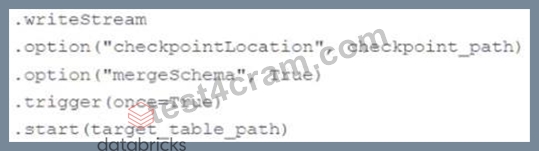
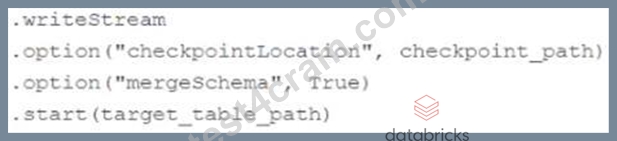
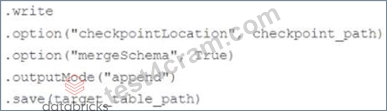
In order to facilitate near real-time workloads, a data engineer is creating a helper function to Get Latest & Actual Certified-Data-Engineer-Professional Exam's Question and Answers from leverage the schema detection and evolution functionality of Databricks Auto Loader. The desired function will automatically detect the schema of the source directly, incrementally process JSON files as they arrive in a source directory, and automatically evolve the schema of the table when new fields are detected.
The function is displayed below with a blank:
Which response correctly fills in the blank to meet the specified requirements?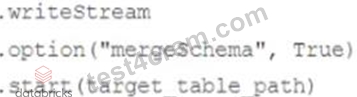
- A. Get Latest & Actual Certified-Data-Engineer-Professional Exam's Question and Answers from
- B.
- C.

- D.
- E.
Answer: D
Explanation:
https://docs.databricks.com/en/ingestion/auto-loader/schema.html
NEW QUESTION # 36
A table is registered with the following code:
Get Latest & Actual Certified-Data-Engineer-Professional Exam's Question and Answers from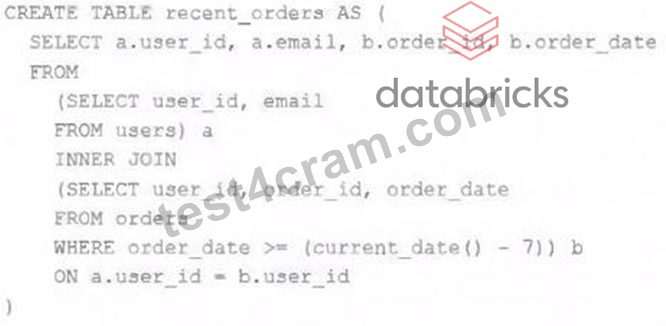
Both users and orders are Delta Lake tables. Which statement describes the results of querying recent_orders?
- A. All logic will execute at query time and return the result of joining the valid versions of the source tables at the time the query began.
- B. The versions of each source table will be stored in the table transaction log; query results will be saved to DBFS with each query.
- C. All logic will execute at query time and return the result of joining the valid versions of the source tables at the time the query finishes.
- D. Results will be computed and cached when the table is defined; these cached results will incrementally update as new records are inserted into source tables.
- E. All logic will execute when the table is defined and store the result of joining tables to the DBFS; this stored data will be returned when the table is queried.
Answer: E
Explanation:
Table is created and data of join will be stored on DBFS and it will be returned on query time.
NEW QUESTION # 37
A Delta Lake table was created with the below query:
Consider the following query:
DROP TABLE prod.sales_by_store
If this statement is executed by a workspace admin, which result will occur?
- A. The table will be removed from the catalog and the data will be deleted.
- B. An error will occur because Delta Lake prevents the deletion of production data.
- C. Nothing will occur until a COMMIT command is executed.
- D. Data will be marked as deleted but still recoverable with Time Travel.
- E. The table will be removed from the catalog but the data will remain in storage.
Answer: A
Explanation:
When a table is dropped in Delta Lake, the table is removed from the catalog and the data is deleted. This is because Delta Lake is a transactional storage layer that provides ACID guarantees. When a table is dropped, the transaction log is updated to reflect the deletion of the table and the data is deleted from the underlying storage.
NEW QUESTION # 38
......
Pass Databricks Databricks-Certified-Data-Engineer-Professional Exam in First Attempt Guaranteed: https://www.test4cram.com/Databricks-Certified-Data-Engineer-Professional_real-exam-dumps.html