

Real Exam Questions MCD-Level-1 Dumps Exam Questions in here [Jun-2024]
Get Latest Jun-2024 Conduct effective penetration tests using MCD-Level-1
The MCD-Level-1 certification exam is a great way for developers to demonstrate their expertise and stand out in the job market. Certification holders can demonstrate to potential employers that they have the skills and knowledge necessary to design, develop, and deploy Mule applications using MuleSoft's Anypoint Platform. Certified developers are also more likely to be considered for advanced or specialized roles within their organizations.
NEW QUESTION # 58
There are three routes configured for Scatter-Gather and incoming event has a payload is an Array of three objects. How routing will take place in this scenario?
- A. Incoming array objects would be split into three and each part would be sent to one route each in sequential manner
- B. Entire event would be sent to each route sequentially
- C. Entire event would be sent to each route in parallel
- D. Incoming array objects would be split into three and each part would be sent to one route each in parallel
Answer: C
Explanation:
Entire event would be sent to each route in parallel.
Scatter-Gather works as follows :
- The Scatter-Gather component receives a Mule event and sends a reference of this Mule event to each processing route.
- Each of the processing routes starts executing in parallel. After all processors inside a route finish processing, the route returns a Mule event, which can be either the same Mule event without modifications or a new Mule event created by the processors in the route as a result of the modifications applied.
- After all processing routes have finished execution, the Scatter-Gather component creates a new Mule event that combines all resulting Mule events from each route, and then passes the new Mule event to the next component in the flow.
NEW QUESTION # 59
Where would you create SLA Tiers for an API?
- A. API Manager
- B. Exchange
- C. In RAML specifications
- D. Anypoint Studio
Answer: A
Explanation:
MuleSoft Doc Ref :
https://docs.mulesoft.com/api-manager/2.x/policy-mule3-tutorial-manage-an-api#to-add-the-tier Steps to create SLA Tier are as follows:
1) In API Manager, in API Administration, click a version.
2) Check that the API supports resource-level policies: On the API version details page, in Status, click Configure Endpoint, and check that Type is RAML.
3) Choose the SLA Tiers, and click Add SLA Tier. Set up limit on SLA tier
NEW QUESTION # 60
Refer to the exhibits.
Larger image
Larger image
Larger image
The Mule application configures and uses two HTTP Listener global configuration elements.
Mule application is run in Anypoint Studio.
If the mule application starts correctly, what URI and port numbers can receive web client requests? If the mule applications fails to start , what is the reason for the failure?
- A. The mule application fails to start because of the port binding conflict as HTTP request also use same port i.e. 3333
- B. The mule application fails to start
There is URL path conflict because both HTTP Listeners are configured with same path - C. The mule application start successfully
Web client requests can be received at URI on port 2222 and on port 3333. - D. The mule application start successfully
Web client requests can only be received at URI on port 2222 but not on port 3333
Answer: C
Explanation:
In this case both the flows can start without any error and requests can be received on both ports. Flow names
httpListener1 can call other flow using HTTP request without any issues.
Hence correct answer is
The mule application start successfully
Web client requests can be received at URI on port 2222 and on port 3333.
Lets check why other options are incorrect
1) The mule application fails to start. There is URL path conflict because both HTTP Listeners are configured with same path ---- This is incorrect as port value is different in both listeners
2) The mule application start successfully. Web client requests can only be received at URI on port 2222 but not on port 3333 --- This is incorrect as there is no reason for not receiving requests on port 3333
3) The mule application fails to start because of the port binding conflict as HTTP request also use same port i.e. 3333 --- Port binding conflict will not happen in this case. It would have if both listener configurations would have been on same port . But that is not the case here.
Mule Ref Doc : HTTP Listener Reference - Mule 4 | MuleSoft Documentation
NEW QUESTION # 61
Pick the component with which DataWeave is tightly integrated.
- A. Exchange
- B. Flow Designer
- C. Mule runtime
- D. All APIs
Answer: C
Explanation:
Correct answer is Mule runtime
DataWeave is the MuleSoft expression language for accessing and transforming data that travels through a Mule app. DataWeave is tightly integrated with the Mule runtime engine, which runs the scripts and expressions in your Mule app.
Mule Doc Reference : https://docs.mulesoft.com/mule-runtime/4.3/dataweave
NEW QUESTION # 62
Refer to the exhibit.
The error occurs when a project is run in Anypoint Studio. The project, which has a dependency that is not in the MuleSoft Maven repository, was created and successfully run on a different computer.
What is the next step to fix the error to get the project to run successfully?
- A. Add the dependency to the MULE_HOME/bin folder
- B. Install the dependency to the computer's local Maven repository
- C. Deploy the dependency to MuleSoft's Maven repository
- D. Edit the dependency in the Mule project's pom.xml file
Answer: B
NEW QUESTION # 63
Refer to the exhibits The Mule application does NOT define any global error handlers.
A web client sends a POST request to the Multi application with this input payload The File Write operation throws a FILECONNECTIVITY error What response message is returned to the web client?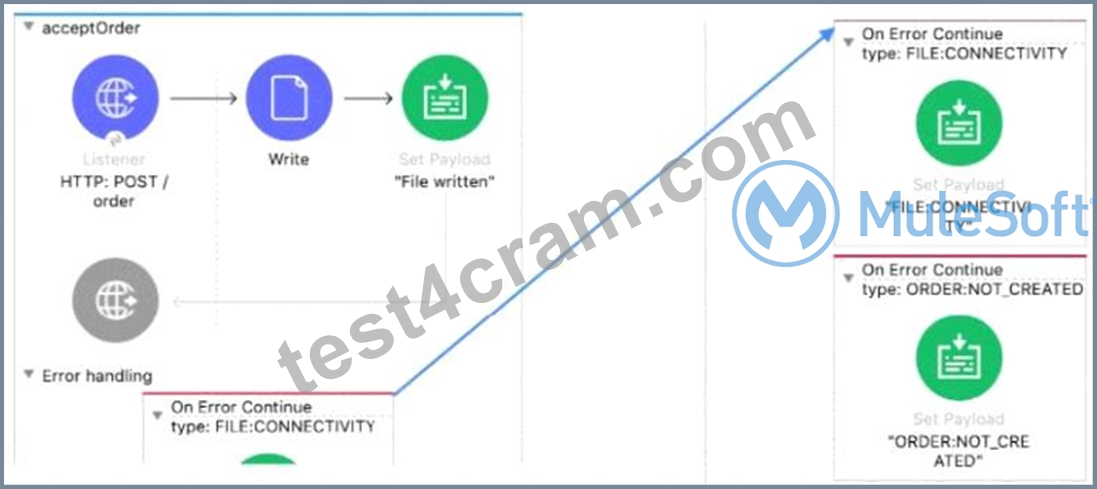

- A. "OTHER ERROR"
- B. "File written"
- C. "ORDER NOT_CREATED"
- D. "FILECONNECTIVITY"
Answer: C
NEW QUESTION # 64
Refer to the exhibit.
What can be added to the flow to persist data across different flow executions?
- A. session variables
- B. properties of the Mule runtime app object
- C. Key/value pairs in the ObjectStore
- D. Properties of the Mule runtime flow object
Answer: C
NEW QUESTION # 65
Refer to the exhibit.
What is the correct syntax to add a customer ID as a URI parameter in an HTTP Listener's path attribute?
- A. (customerlD)
- B. #[customerlD]
- C. {customerlD}
- D. ${ customerID}
Answer: C
NEW QUESTION # 66
Refer to exhibits.
In the execution of the Scatter-Gather , the flow route completes after 10 seconds and the flow2 route completes in 40 seconds. How many seconds does it take for the Scatter-Gather to complete?
- A. 0
- B. 1
- C. 2
- D. 3
Answer: A
Explanation:
Scatter-Gather sends the event to each routes concurrently. Hence both route in this example will start in parallel. So total time to complete processing is 40 seconds which is option 3
NEW QUESTION # 67
Refer to the exhibit.
All three of the condition for the Choice router are true. What log messages are written?
- A. Route1, Route2, Default
- B. Route 1
- C. Route2
- D. Route1, Route2
Answer: B
NEW QUESTION # 68
A company has an API to manage departments, with each department identified by a unique deptld. The API was built with RAML according to MuleSoft best practices.
What is valid RAML to specify a method to update the details for a specific department?
A)
B)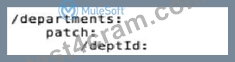
C)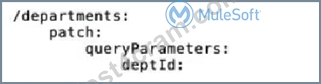
D)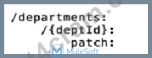
- A. Option C
- B. Option D
- C. Option A
- D. Option B
Answer: B
NEW QUESTION # 69
A
Mule application contains two HTTP Listeners, each configured for different API endpoints:
http://acme.com/apis/orders and http: //acme .com/a pis/customers.
What base path value should be set in an HTT? Listener config element so that it can be used to configure both HTTP Listeners?
- A. /apis/
- B. /apis/*
- C. /apis/orders|customers
- D. /apis/?
Answer: A
NEW QUESTION # 70
Refer to the exhibits.
What payload and quantity are togged at the end of the main flow?
- A. [[1,2,3,4], 14]
- B. [[order1, order2, order3, order4], 14]
- C. [[1,2,3,4], 10]
- D. [orderlorder2order3order4, 14]
Answer: A
NEW QUESTION # 71
A
Mule application contains two HTTP Listeners, each configured for different API endpoints:
http://acme.com/apis/orders and http: //acme .com/a pis/customers.
What base path value should be set in an HTT? Listener config element so that it can be used to configure both HTTP Listeners?
- A. /apis/orders|customers
- B. /apis/
- C. /apis/?
- D. /apis/*
Answer: D
NEW QUESTION # 72
A web client submits a request to http://localhost:8081?flrstName=john. What is the correct DataWeave expression to access the firstName parameter?
- A. #[attributes.'http.query.params'.firstName]
- B. #[attributes.queryParams.firstName]
- C. #[message.queryParams.hrstName]
- D. #[message.inboundProperties.'http.query.params'.firstName]
Answer: B
NEW QUESTION # 73
What happens to the attributes of a Mule event in a flow after an outbound HTTP Request is made?
- A. Attributes are replaced with new attributes from the HTTP Request response (which might be null)
- B. Attributes do not change
- C. New attributes may be added from the HTTP response headers, but no headers are ever removed
- D. Previous attributes are passed unchanged
Answer: A
Explanation:
Attributes are replaced with new attributes from the HTTP Request response.
Attributes include everything apart from Payload/body. For ex: Headers, query parameters, URI parameters.
So, when outbound HTTP request is made, new attributes need to pass the outbound HTTP request and old attributes are replaced.
I have created below diagram to make it easy for you to understand:
Diagram Description automatically generated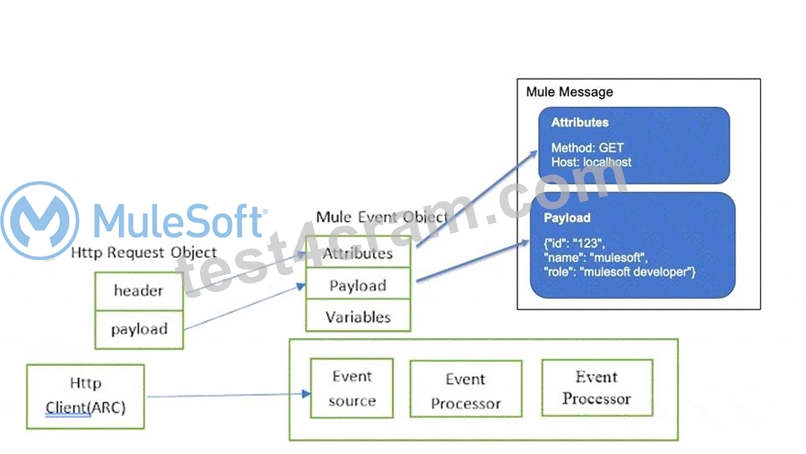
NEW QUESTION # 74
What is the object type returned by the File List operation?
- A. Object of String file names
- B. Array of Mule event objects
- C. Object of Mule event objects
- D. Array of String file names
Answer: B
Explanation:
The List operation returns an array of messages in which: Each message holds the file's content in its payload.
The file's attributes section carries the file's metadata (such as name, creation time, and size). The payload is empty if the element is a folder.
NEW QUESTION # 75
Refer to the exhibit.
All three of the condition for the Choice router are true. What log messages are written?
- A. Route1, Route2, Default
- B. Route 1
- C. Route2
- D. Route1, Route2
Answer: B
NEW QUESTION # 76
Refer to the exhibit.

The main flow is configured with their error handlers. A web client submit a request to the HTTP Listener and the HTTP Request throws an HTTP:NOT_FOUND error.
What response message is returned?''
What response message is returned?
- A. APP: API RESOURCE NOT FOUND
- B. HTTP: NOT FOUND
- C. success - main flow
- D. other error
Answer: A
Explanation:
Correct answer is APP: API RESOURCE NOT FOUND
---------------------------------------------------------------------------------------------------------------------------------------------------
1) A web client submits the request to the HTTP Listener.
2) The HTTP Request throws an "HTTP:NOT_FOUND" error, execution halts.
3) The On Error Propagate error Handler handles the error. In this case ,HTTP:NOT_FOUND error is mapped to custom error APP:API_RESOURCE_NOT_FOUND. This error processor sets payload to APP:API_RESOURCE_NOT_FOUND.
4) "APP:API_RESOURCE_NOT_FOUND. " is the error message returned to the requestor in the body of the HTTP request with HTTP Status Code: 500 Reference Diagram:
NEW QUESTION # 77
What is the difference between a subflow and a sync flow?
- A. No difference
- B. Subflow is synchronous and sync flow is asynchronous
- C. Subflow has no error handling of its own and sync flow does
- D. Sync flow has no error handling of its own and subflow does
Answer: C
Explanation:
Correct answer is Subflow has no error handling implementation where as sync flow has.
Subflow
A subflow processes messages synchronously (relative to the flow that triggered its execution) and always inherits both the processing strategy and exception strategy employed by the triggering flow. While a subflow is running, processing on the triggering flow pauses, then resumes only after the subflow completes its processing and hands the message back to the triggering flow.
Synchronous Flow
A synchronous flow, like a subflow, processes messages synchronously (relative to the flow that triggered its execution). While a synchronous flow is running, processing on the triggering flow pauses, then resumes only after the synchronous flow completes its processing and hands the message back to the triggering flow. However, unlike a subflow, this type of flow does not inherit processing or exception strategies from the triggering flow.
This type of flow processes messages along a single thread, which is ideally suited to transactional processing
NEW QUESTION # 78
Refer to the exhibits. APIKit router is used to generate the flow components for RAML specification.
The Mule application must be available to REST clients using the two URL's
http://localhost:8081/internal
and http://localhost:8081/external
How many APIKit Router components are generated to handle requests to every endpoint defined in RAML specification?
1.Library.raml
2./books
3. get:
4. post:
5./order:
6. get
7. patch
8./members
9. get:
- A. 0
- B. 1
- C. 2
- D. 3
Answer: D
NEW QUESTION # 79
A
Mule application contains two HTTP Listeners, each configured for different API endpoints:
http://acme.com/apis/orders and http: //acme .com/a pis/customers.
What base path value should be set in an HTT? Listener config element so that it can be used to configure both HTTP Listeners?
- A. /apis/orders|customers
- B. /apis/
- C. /apis/?
- D. /apis/*
Answer: D
Explanation:
Option 2 is the correct answer as /api/* accespts everything starting with /api/
NEW QUESTION # 80
Refer to the exhibit.
What data is expected by the POST /accounts endpoint?
A)
B)
C)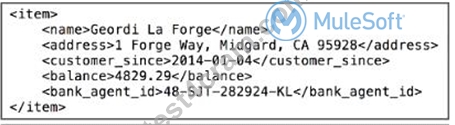
D)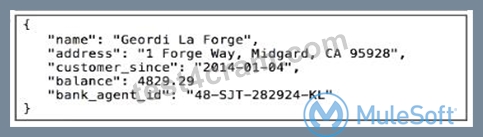
- A. Option C
- B. Option D
- C. Option A
- D. Option B
Answer: B
NEW QUESTION # 81
A Mule application contains a global error handler configured to catch any errors.
Where must the global error handler be specified so that the global error handler catches all errors from flows without their own error handlers?
- A. Nowhere, the global error handler is automatically used
- B. A configuration properties file
- C. A global element
- D. The pom.xml file
Answer: C
Explanation:
Correct answer is A global element
Global error handlers are to be created in global element .
Quick note to remember here is Global error handlers come in to picture only when there are no error handlers specified as flow level.
Steps to create Global error handler
1) Click Global Elements to open Global Configuration Elements. Global Elements is located below the Studio canvas
2) In Global Configuration Elements, click Create to open the Choose Global Type dialog Graphical user interface, text, application, chat or text message Description automatically generated
3) From the dialog, select Global Configuration - Configuration, and then click OK to open the Configuration dialog.
Graphical user interface, text, application, email Description automatically generated
4) From the select Configuration dialog, select allErrorHandler for the Default Error Handler field, and click OK.
NEW QUESTION # 82
An API instance of type API endpoint with API proxy is created in API manager using an API specification from Anypoint Exchange. The API instance is also configured with an API proxy that is deployed and running in CloudHub.
An SLA- based policy is enabled in API manager for this API instance.
Where can an external API consumer obtain a valid client ID and client secret to successfully send requests to the API proxy?
- A. In the organization's public API portal in Anypoint Exchange, from an approved client application for the API proxy
- B. In Anypoint Studio, from components generated by Rest Connect for API specification
- C. In Runtime Manager, from the properties tab of the deployed approved API proxy
- D. In Anypoint Studio, from components generated by APIkit for the API specification
Answer: A
Explanation:
* When a client application is registered in Anypoint Platform, a pair of credentials consisting of a client ID and client secret is generated.
* When the client application requests access to an API, a contract is created between the application and that API.
* An API that is protected with a Client ID Enforcement policy is accessible only to applications that have an approved contract.
--------------------------------------------------------------------------------------------------------------------------------------------- Correct answer: In the organization's public API portal in Anypoint Exchange, from an approved client application for the API proxy
NEW QUESTION # 83
......
To prepare for the MCD-Level-1 exam, candidates can take advantage of various resources provided by MuleSoft, including training courses, documentation, and online forums. Hands-on experience with Mule 4 is also essential to pass the exam. MCD-Level-1 exam consists of 60 multiple-choice questions that must be completed within 120 minutes. The passing score for the exam is 70%.
Authentic Best resources for MCD-Level-1 Online Practice Exam: https://www.test4cram.com/MCD-Level-1_real-exam-dumps.html