

SAVIGA-C01 Actual Questions Answers Pass With Real SAVIGA-C01 Exam Dumps
SAVIGA-C01 Dumps Prepare Your Exam With 62 Questions
NEW QUESTION # 13
Match the following SoD Violations status with their description.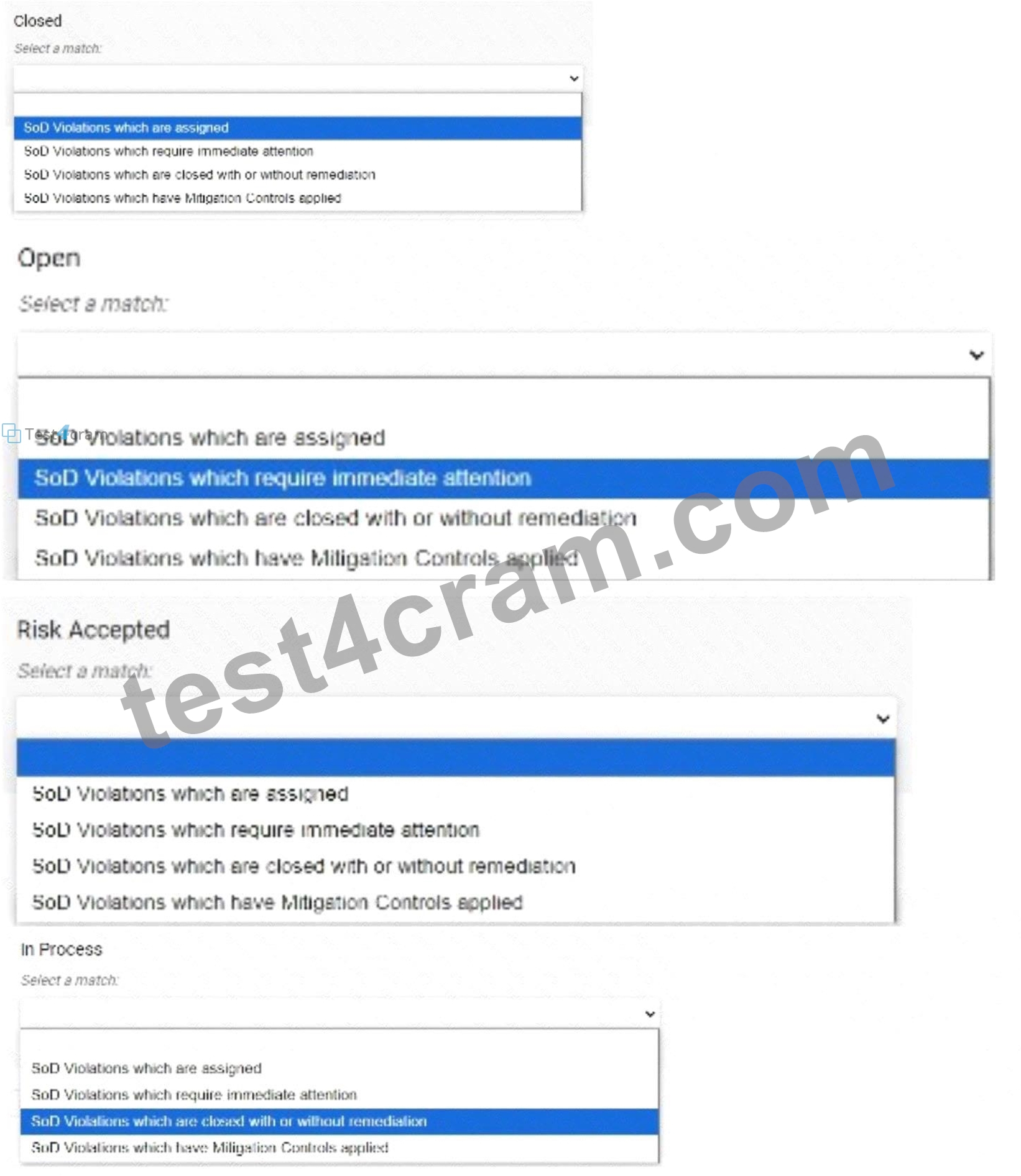
Answer:
Explanation: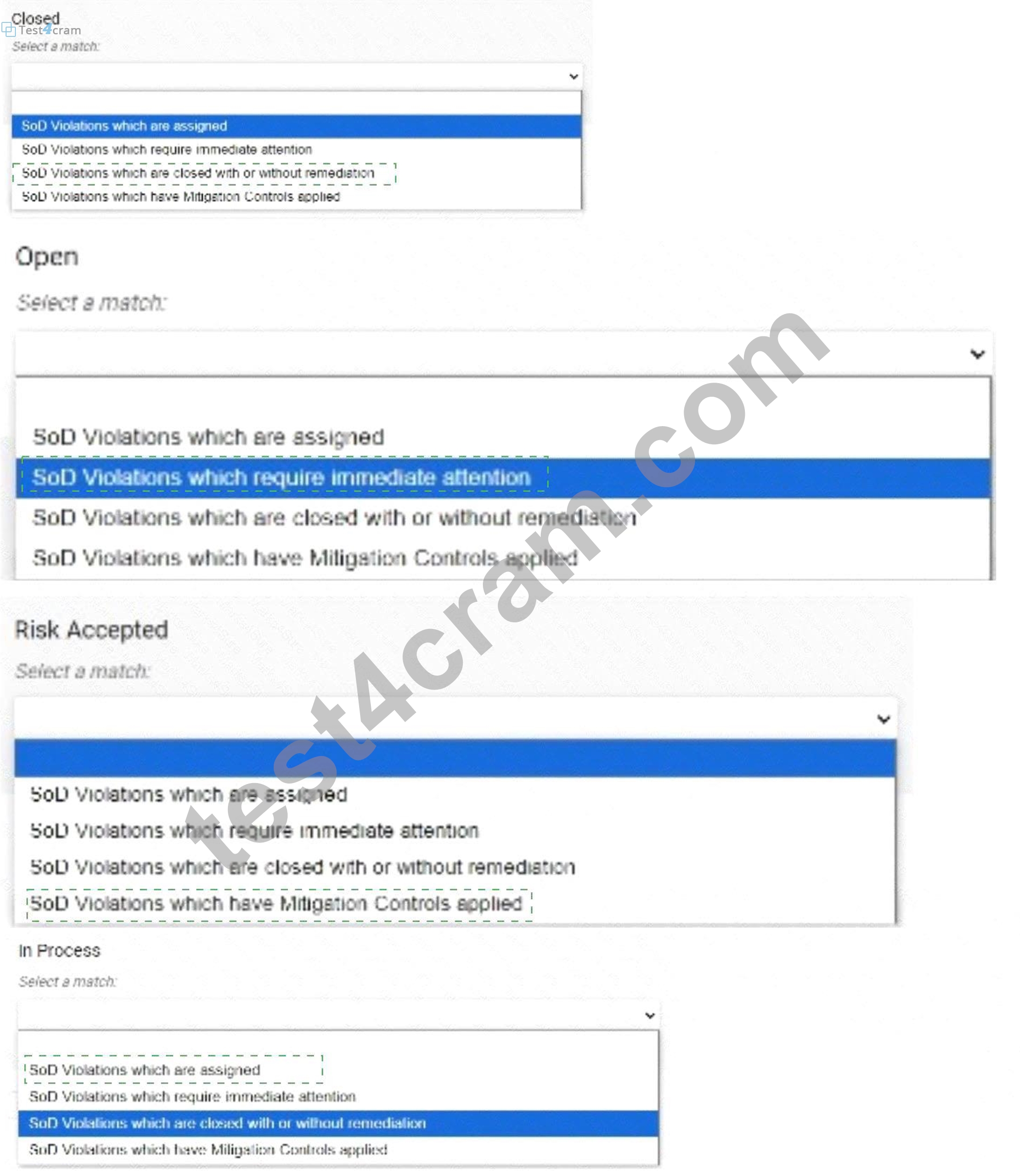
Explanation:
* Closed: SoD Violations which are closed with or without remediation
* Open: SoD Violations which require immediate attention
* Risk Accepted: SoD Violations which have Mitigation Controls applied
* In Process: SoD Violations which are assigned
* Closed: This status implies that the SoD violation has been addressed. It could have been resolved through remediation (e.g., removing conflicting access) or through acceptance after a review process (without direct remediation, perhaps mitigated in another way).
* Open: This status indicates that the SoD violation is active and needs immediate attention to mitigate the associated risk.
* Risk Accepted: This status suggests that the SoD violation has been acknowledged, but instead of being fully remediated, mitigation controls have been put in place to reduce the risk to an acceptable level. This usually follows a formal risk acceptance process.
* In Process: This status means that the SoD violation is currently being worked on. It has likely been assigned to someone for investigation, remediation, or further action.
Therefore, the matches you've made in the image are accurate and reflect standard SoD management practices.
NEW QUESTION # 14
________ filters the requestable applications under "Request New Access."
- A. Access Add Workflow
- B. Whom to Request
- C. Access Query
- D. Provisioning Connection
Answer: C
Explanation:
The component that filters the requestable applications under "Request New Access" in Saviynt is the Access Query. Here's a detailed explanation:
* Saviynt's Access Request System (ARS): As the front end for requesting access, the ARS needs a mechanism to determine which applications (and entitlements) should be displayed to a user as requestable.
* Access Query: This is a powerful feature within Saviynt that allows administrators to define specific criteria to control the visibility of applications and entitlements in the ARS. Think of it as a filter that determines what a user can see and request.
* How Access Queries Work:
* Defined on Applications/Entitlements: Access Queries are configured on individual applications or entitlements within Saviynt.
* Based on User Attributes: They use user attributes (e.g., department, location, job title, group memberships) and other criteria (e.g., risk level) to determine if a user should see a particular application or entitlement.
* Dynamic Filtering: When a user accesses the "Request New Access" section, Saviynt evaluates the Access Queries associated with each application and entitlement in real-time. Based on the user's attributes, the system dynamically filters the list, showing only the applications and entitlements that match the query conditions.
* Saviynt's Security Model: Access Queries are a fundamental part of Saviynt's security model. They ensure that users are only presented with access options that are relevant and appropriate for their role and context, preventing accidental over-provisioning and reducing the attack surface.
* Other Options:
* Access Add Workflow: While essential for processing access requests, the workflow itself doesn't filter which applications are initially displayed.
* Provisioning Connection: This relates to how Saviynt connects to target systems for automated provisioning. It doesn't control the initial visibility of applications in the ARS.
* Whom to Request: This setting might determine the available approvers, but it doesn't filter the list of requestable applications.
In essence: Access Queries act as a dynamic filter, leveraging user attributes and defined criteria to determine which applications and entitlements are presented to a user within Saviynt's "Request New Access" interface, ensuring a personalized and secure access request experience.
NEW QUESTION # 15
In the process of setting up Single Sign-On using SAML 2.0, the "SP Entity ID" acts as a unique identifier for the Saviynt SP. If "SP Entity ID" is set to the value of SaviyntSP, which of the following will be the correct Single Sign-On URL to log in to EIC?
- A. https://myorg.saviyntcloud.com/SaviyntSP
- B. https://myorg.saviyntcloud.com/ECM/saml/SSO/SaviyntSP
- C. https://myorg.saviyntcloud.com/ECM/saml/SSO/alias/SaviyntSP
Answer: C
Explanation:
In Saviynt's SAML 2.0 based Single Sign-On (SSO) configuration, the "SP Entity ID" uniquely identifies Saviynt as the Service Provider (SP) to the Identity Provider (IdP). The correct SSO URL structure incorporates this "SP Entity ID" within a specific path.
* Saviynt's URL Structure: Saviynt's SSO URLs follow a pattern to ensure proper routing and authentication. The /ECM/saml/SSO/alias/ portion is crucial for directing SAML-based login attempts.
Why the other options are incorrect:
* A. https://myorg.saviyntcloud.com/ECM/saml/SSO/SaviyntSP: This URL is missing the crucial " alias" segment in the path, making it invalid for SAML SSO.
* B. https://myorg.saviyntcloud.com/SaviyntSP: This URL doesn't include the necessary components for SAML-based authentication within Saviynt.
Saviynt IGA References:
* Saviynt Documentation: Saviynt's official documentation on configuring SAML SSO provides details on the correct URL structure and the significance of the "SP Entity ID."
* Saviynt Support: Saviynt's support resources and knowledge base articles often address issues related to SSO configuration, reinforcing the correct URL format
NEW QUESTION # 16
Which of the following options can a Campaign Owner use to view the Entitlements Query that was used in a previously launched Campaign?
- A. Campaign Export
- B. Reconfigure option
- C. Export option at the top right corner of the page, next to the Refresh Progress option
- D. Campaign Summary
Answer: D
Explanation:
To view the Entitlements Query used in a previously launched Campaign in Saviynt, a Campaign Owner can use the C. Campaign Summary. Here's why:
* Saviynt's Campaign Summary: The Campaign Summary provides a detailed overview of a campaign's configuration, including:
* Campaign Scope: The users, applications, or entitlements included in the campaign.
* Filters and Queries: Any filters or queries used to define the campaign scope, including the Entitlements Query.
* Certifier Information: Details about the assigned certifiers.
* Schedule: The campaign's start and end dates.
* Status: The current status of the campaign (e.g., Active, Completed, Expired).
* Accessing the Entitlements Query: The Campaign Summary typically includes a section that displays the exact query used to select the entitlements included in the campaign.
* Why Other Options Are Less Suitable:
* A. Reconfigure option: While you might be able to see the query by going into the reconfiguration, it's not the most direct way. The Campaign Summary is designed to provide this information readily.
* B. Campaign Export: Exporting the campaign data might include the list of entitlements but not necessarily the original query used to select them.
* D. Export option at the top right corner of the page, next to the Refresh Progress option:
This option typically exports the current view of the campaign data, not the underlying configuration details like the Entitlements Query.
In conclusion: The Campaign Summary in Saviynt is the most direct and convenient place for a Campaign Owner to review the detailed configuration of a campaign, including the Entitlements Query used to define the campaign's scope.
NEW QUESTION # 17
Which of the following features best describe the Authorization mechanism for the EIC application?
- A. WSRETRY Job
- B. SSO
- C. Security System
Answer: C
Explanation:
The feature that best describes the Authorization mechanism for the EIC (Enterprise Identity Cloud) application in Saviynt is A. Security System. Here's an explanation:
* Saviynt's Security System: This is the core component within Saviynt that handles authentication and authorization for various applications and resources, including EIC.
* Authorization in EIC: The Security System determines what actions users are allowed to perform within EIC, such as:
* Creating, updating, or deleting users.
* Managing roles and entitlements.
* Running reports.
* Configuring connections.
* Role-Based Access Control (RBAC): The Security System typically uses RBAC to manage these permissions. Users are assigned to roles, and roles are granted specific permissions within EIC.
* Why Other Options Are Less Relevant:
* B. SSO (Single Sign-On): SSO is an authentication mechanism that allows users to log in once and access multiple applications. While Saviynt supports SSO, it's not the primary authorization mechanism for EIC.
* C. WSRETRY Job: This is a job related to retrying web service calls, not authorization.
NEW QUESTION # 18
________ allows detection of access rights granted outside the Saviynt platform.
- A. ARS > Request Access for Others
- B. REST API
- C. Bulk Upload
- D. RevokeOutOfBandAccessJob
Answer: D
Explanation:
The Saviynt feature that allows detection of access rights granted outside the Saviynt platform is the B.
RevokeOutOfBandAccessJob. Here's a detailed explanation:
* Out-of-Band Access: This refers to access that is provisioned directly in the target system, bypassing the normal access request and approval processes within Saviynt. This can create security risks and compliance issues.
* Saviynt's Reconciliation Process: Saviynt uses a reconciliation process to compare the access rights defined within its system with the actual access rights present in connected applications.
* RevokeOutOfBandAccessJob: This specific job is designed to identify and flag out-of-band access. It works by:
* Importing Account and Entitlement Data: The job imports data from the target system, capturing the current state of user access.
* Comparing with Saviynt Data: It compares this imported data with the access rights managed within Saviynt.
* Identifying Discrepancies: Any discrepancies, where a user has access in the target system that wasn't granted through Saviynt, are identified as out-of-band access.
* Taking Action (Optional): The job can be configured to automatically revoke this out-of-band access or to simply generate a report for review and manual remediation. Or it can be configured to create a task for an administrator to review.
* Saviynt's Access Governance: This feature is a crucial part of Saviynt's overall access governance capabilities, helping organizations maintain control over user access and enforce the principle of least privilege.
* Other Options:
* A. REST API: While Saviynt's REST API can be used to interact with the system and potentially retrieve access data, it's not the specific feature designed for out-of-band access detection.
* C. Bulk Upload: This is a method for importing data into Saviynt, but it doesn't inherently detect out-of-band access.
* D. ARS > Request Access for Others: This is part of the access request process, not related to detecting access granted outside of Saviynt.
In conclusion: The RevokeOutOfBandAccessJob in Saviynt plays a vital role in identifying and remediating out-of-band access, ensuring that access rights are managed centrally and consistently through the Saviynt platform.
NEW QUESTION # 19
The Sales department of a company requires an approval workflow to be created for an application where the Manager's approval should be followed by the Application Owner's approval. Which of the following sequences form the correct order of the workflow events?
- A. Start > Resource Owner's Approval > Manager's Approval > Approve/Reject > End
- B. Start > Manager's Approval > Resource Owner's Approval > Approve/Reject > End
- C. Start > Manager's Approval > Custom Assignment > Approve/Reject > End
- D. Start > Manager's Approval > Access Approval > Approve/Reject > End
Answer: B
Explanation:
The correct sequence of workflow events for an application where the Manager's approval should be followed by the Application Owner's approval is D. Start > Manager's Approval > Resource Owner's Approval > Approve/Reject > End. Here's a breakdown:
* Saviynt's Workflow Structure: Saviynt workflows follow a sequential structure, starting with a
"Start" event and ending with an "End" event.
* Workflow Activities: Each step in the workflow is represented by an activity, such as an approval task.
* Manager's Approval: In this scenario, the first required approval is from the Manager. This would be represented by a "TASK Access Approve" activity (or similar, depending on the specific configuration) assigned to the user's manager.
* Application Owner's Approval: After the Manager's approval, the workflow needs to proceed to the Application Owner for their approval. This would be another "TASK Access Approve" activity assigned to the Application Owner. In Saviynt terms, Application Owner is a type of Resource Owner.
* Approve/Reject: This activity represents the decision point where the final approver (in this case, the Application Owner) either approves or rejects the request.
* End: The workflow concludes with the "End" event, signifying the completion of the process.
* Other Options:
* A. Start > Resource Owner's Approval > Manager's Approval > Approve/Reject > End:
Incorrect order; the manager's approval should come before the application owner's.
* B. Start > Manager's Approval > Custom Assignment > Approve/Reject > End: "Custom Assignment" is not the most appropriate activity for a standard approval step. "TASK Access Approve" would be more suitable.
* C. Start > Manager's Approval > Access Approval > Approve/Reject > End: "Access Approval" is a bit redundant; "TASK Access Approve" assigned to the appropriate role is clearer.
In essence: The correct workflow sequence accurately reflects the required approval hierarchy: first the Manager, then the Application Owner, followed by the final decision (Approve/Reject) and the end of the workflow.
NEW QUESTION # 20
Which of the following formats is suitable for downloading an Analytics report? (Select all that apply)
- A. CSV file and Excel Sheet
- B. CSV file only
- C. Text file
Answer: A
Explanation:
The formats suitable for downloading an Analytics report in Saviynt typically include A. CSV file and Excel Sheet. Here's an explanation:
* Saviynt's Reporting Capabilities: Saviynt provides options for exporting and downloading analytics reports in various formats to facilitate data sharing and further analysis.
* Common Export Formats:
* CSV (Comma Separated Values): A widely used format for storing tabular data in plain text.
It's easily imported into various data analysis tools and spreadsheet programs.
* Excel Sheet (e.g., .xlsx): A popular spreadsheet format that allows for data organization, formatting, and calculations.
* Why These Formats Are Suitable:
* Data Analysis: Both CSV and Excel formats are well-suited for further data analysis and manipulation.
* Reporting: They are commonly used for creating reports and sharing data with stakeholders.
* Compatibility: Most data analysis and reporting tools support these formats.
* Other Less Common Options: While less frequent, Saviynt might offer other export formats like PDF, depending on the specific version and configuration.
* B. Text file: Although technically a text file, a raw .txt export might not be as useful for structured data like analytics reports. CSV would be preferred.
In conclusion: CSV and Excel are the most common and practical formats for downloading analytics reports from Saviynt, offering flexibility for data analysis, reporting, and sharing.
NEW QUESTION # 21
Which of the following Application types can be associated with the Automated Provisioning configuration turned OFF?
- A. Hybrid Application
- B. Connected Application
- C. Disconnected Application
- D. Service Desk Application
Answer: C
Explanation:
Disconnected applications in Saviynt are those that do not have real-time integration with the platform for provisioning and de-provisioning users. Therefore, automated provisioning would be turned OFF for these types of applications.
* Disconnected Applications: These applications typically require manual intervention or custom scripts to manage user access. Saviynt can still manage entitlements and access requests for these applications, but it doesn't directly provision or de-provision accounts.
* Other Application Types:
* Service Desk Application: Usually integrated with Saviynt for automated request fulfillment.
* Hybrid Application: May have some level of automated provisioning, depending on the specific configuration.
* Connected Application: Fully integrated with Saviynt for real-time, automated provisioning.
Saviynt IGA References:
* Saviynt Documentation: The section on Application Onboarding in Saviynt's documentation explains the different application types and their integration capabilities, including the concept of disconnected applications.
NEW QUESTION # 22
Where can an Admin get the details of a successfully executed Rule?
- A. Action Trail
- B. Current Rule Trail
- C. Archived Application Logs
- D. Archived Rule Trail
Answer: B
Explanation:
To get the details of a successfully executed Rule in Saviynt, an Admin should look in the C. Current Rule Trail. Here's why:
* Saviynt's Rule Engine and Logging: Saviynt's rule engine executes various types of rules (e.g., birthright rules, user update rules, technical rules). It maintains logs to track rule execution and outcomes.
* Current Rule Trail: This log specifically captures the details of recently executed rules, including:
* Rule Name: The name of the rule that was executed.
* Execution Time: The timestamp of when the rule was executed.
* Status: Whether the rule execution was successful or not.
* Details: Specific information about the rule's execution, such as the conditions that were evaluated and the actions that were taken.
* Troubleshooting and Auditing: The Current Rule Trail is invaluable for troubleshooting rule behavior and for auditing purposes, providing a clear record of what rules were executed and their results.
* Other Options:
* A. Archived Rule Trail: This log stores details of older rule executions that have been archived.
It's useful for historical analysis but not for recent executions.
* B. Archived Application Logs: These logs are related to application activity, not rule execution.
* D. Action Trail: The Action Trail captures general user and administrative actions within Saviynt, but it might not provide the detailed information about rule execution that the Current Rule Trail does.
NEW QUESTION # 23
Which of the following Connections is used for integrating Saviynt with a ticketing system?
- A. Ticket Connection
- B. Service Ticket Connection
- C. Service Desk Connection
- D. Provisioning Connection
Answer: C
Explanation:
A Service Desk Connection in Saviynt is used to integrate with external ticketing systems. This integration allows Saviynt to:
* Automate request fulfillment: Access requests created in Saviynt can automatically generate tickets in the service desk system.
* Track request status: Saviynt can update the status of access requests based on the corresponding ticket status in the service desk system.
* Improve communication: Integration facilitates seamless communication and collaboration between Saviynt and the service desk team.
Why other options are incorrect:
* Service Ticket Connection, Ticket Connection, Provisioning Connection: These are not standard terms used in Saviynt for service desk integration.
Saviynt IGA References:
* Saviynt Documentation: The documentation on integrating with Service Desk systems explains the purpose and configuration of a Service Desk Connection.
* Saviynt Connectors: Saviynt provides connectors for popular service desk solutions like ServiceNow, facilitating the integration process.
NEW QUESTION # 24
Which of the following statuses is applicable for the "Add Access" task type when the task is successfully completed?
- A. Provisioned
- B. Active
- C. Manually Provisioned
- D. Success
Answer: A
Explanation:
When an "Add Access" task is successfully completed in Saviynt, the applicable status is typically " Provisioned." Here's a detailed explanation with Saviynt references:
* Saviynt's Task Management: Saviynt uses tasks to track the progress of various operations, including access provisioning. These tasks are generated as part of workflows, such as the "Access Add Workflow."
* "Add Access" Task Type: This specific task type is created when the access request is approved and the system is ready to grant the requested access to the target application.
* Task Statuses in Saviynt: Saviynt uses different statuses to indicate the current state of a task.
Common statuses include:
* Pending: The task is waiting to be processed.
* In Progress: The task is currently being executed.
* Provisioned: This status signifies that the requested access has been successfully granted to the user in the target system.
* Failed: The task encountered an error and could not be completed.
* Manually Provisioned: The task was completed manually by an administrator, rather than through automated provisioning.
* Success: While sometimes used, this status is less specific than "Provisioned" in the context of
"Add Access" tasks, since it does not specify that the action completed was a provisioning action.
* Active: Typically applies to accounts or users, not tasks.
* Saviynt's Workflow Engine: The workflow engine in Saviynt updates the task status as it progresses through the defined steps. For connected applications, the workflow engine might directly interact with the target system's API to provision the access. Once the provisioning is successful, the status is updated to "Provisioned."
* Saviynt's Audit Trails: Saviynt maintains detailed audit trails, and the task status changes are logged.
This provides a clear record of when access was provisioned for a user.
* Other Options:
* Success: As mentioned above, this is a general status. While technically correct (the task succeeded), "Provisioned" provides more context.
* Manually Provisioned: This status is only applicable if an administrator intervened and manually granted the access outside of the automated workflow.
* Active: This status typically pertains to a user or account's overall status, not specifically to the completion of an "Add Access" task.
NEW QUESTION # 25
As an Admin, you are required to set up an Entitlement Owner Campaign for Entitlements belonging to an Oracle ERP Endpoint by the Internal Audit team. The Campaign should be launched at the beginning of every month, and only Accounts and Entitlements that meet the prerequisites should be included in the Campaign.
Which of the following 2-key configurations would you recommend for achieving this?
- A. Use Campaign Template and the Schedule Later option
- B. Use Advanced Configurations and set the Campaign expiry to 31 days
- C. Use Advanced Configurations and Preview mode and create the Campaign at the beginning of each month
- D. Cannot be achieved
Answer: A
Explanation:
To set up an Entitlement Owner Campaign for Entitlements belonging to an Oracle ERP Endpoint that launches at the beginning of every month, and includes only Accounts and Entitlements that meet the prerequisites, the 2-key configurations you should recommend are A. Use Campaign Template and the Schedule Later option. Here's a breakdown:
* Campaign Template:
* Purpose: Templates allow you to save a set of campaign configurations as a reusable template.
This is ideal for recurring campaigns with consistent settings.
* Benefits: Using a template saves time and ensures consistency across multiple campaign instances. You can define the scope (Oracle ERP Endpoint), Certifier type (Entitlement Owners), and other settings within the template.
* Prerequisites: You can include logic within the template to filter for Accounts and Entitlements that meet the defined prerequisites.
* Schedule Later option:
* Purpose: This option allows you to schedule the campaign to launch at a specific date and time in the future.
* Recurring Scheduling: You can configure the campaign to run on a recurring schedule, such as the beginning of every month.
* Automation: This automates the campaign launch process, eliminating the need for manual intervention each month.
* Why Other Options Are Less Suitable:
* B. Use Advanced Configurations and Preview mode and create the Campaign at the beginning of each month: This approach is manual and prone to errors. It doesn't leverage the automation benefits of templates and scheduling.
* C. Use Advanced Configurations and set the Campaign expiry to 31 days: While setting an expiry is important, it doesn't address the need for recurring monthly launches or using a template for consistent configuration.
* D. Cannot be achieved: This is incorrect; the scenario can be easily achieved using Campaign Templates and the Schedule Later option.
NEW QUESTION # 26
Marty, an Administrator, reconciled Oracle Accounts into Saviynt. During the import, the incoming accounts were required to be mapped to the existing users in Saviynt. Which of the following Rules should be used to successfully associate Accounts to the correct users?
- A. Account Name Rule
- B. Technical Rule
- C. User Account Correlation Rule
- D. Account to User Rule
Answer: C
Explanation:
User Account Correlation Rules in Saviynt are specifically designed to map imported accounts to existing users within the system. These rules define the logic for matching accounts to users based on various attributes, such as employee ID, email address, or username.
Why other options are incorrect:
Account to User Rule: This is not a standard rule type in Saviynt.
Account Name Rule: This might focus on naming conventions for accounts, not correlating them to users.
Technical Rule: This is a broader category of rules and doesn't specifically address account-user mapping.
Saviynt IGA References:
Saviynt Documentation: The section on Account Correlation Rules provides detailed information on how to configure these rules for different scenarios.
Saviynt Use Cases: Saviynt often provides examples and use cases demonstrating how to use User Account Correlation Rules to automate account mapping during imports.
NEW QUESTION # 27
The following USER_IMPORT_MAPPING attribute is set up in Workday RAAS connection:
USER_IMPORT_MAPPING
{
"ImportType": "RAAS",
"ResponsePath": "wd:Report_Data.wd:Report_Entry",
"ImportMapping": {
"USERNAME": "wd:User_Name~#~string",
"SYSTEMUSERNAME": "wd:User_Name~#~string",
"FIRSTNAME": "wd:First_Name~#~string",
"CITY": "wd:Location.wd:Descriptor~#~string"
}
}
As per the above mapping, USERNAME is the user attribute defined in Workday, and User_Name is the attribute defined in EIC.
- A. True
- B. False
Answer: B
Explanation:
The statement is False. In the provided USER_IMPORT_MAPPING, USERNAME is the user attribute defined in EIC (Enterprise Identity Cloud), and wd:User_Name is the attribute defined in Workday. Here's a breakdown:
* Saviynt's USER_IMPORT_MAPPING: This configuration within a connection (in this case, Workday RAAS) defines how data from the connected system (Workday) should be mapped to attributes within Saviynt's EIC.
* ImportMapping: This section specifies the mapping between source attributes (Workday) and target attributes (EIC).
* USERNAME: In the provided mapping, USERNAME (without the wd: prefix) is the target attribute, meaning it's an attribute within Saviynt's EIC.
* wd:User_Name: The wd: prefix typically indicates a Workday attribute. Therefore, wd:User_Name is the source attribute from Workday.
* ~#~string: This likely indicates the data type of the attribute (string in this case).
* Correct Interpretation: The mapping is saying: "Take the value of the wd:User_Name attribute from Workday and map it to the USERNAME attribute in EIC." In essence: The USER_IMPORT_MAPPING defines how data from Workday is translated into Saviynt's internal data model, and in this case, USERNAME belongs to Saviynt (EIC), while wd:User_Name belongs to Workday.
NEW QUESTION # 28
ABC Company has set up a one-level workflow for an application, where the lone approver is the manager of the beneficiary. Margaret, who is Edward's manager, raised an access request on behalf of Edward. Which of the following statements would be true/applicable?
- A. Manager's approval is auto-rejected
- B. None of the above
- C. Manager must manually approve/reject the request
- D. Manager's approval is auto-approved
Answer: D
Explanation:
In the given scenario, where ABC Company has a one-level workflow with the manager as the sole approver, and Margaret (Edward's manager) raises a request on behalf of Edward, the statement that would be true
/applicable is A. Manager's approval is auto-approved. Here's why:
* Saviynt's Workflow Configuration: Saviynt allows for the configuration of various workflow scenarios, including auto-approval based on certain conditions.
* Self-Approval Prevention/Auto-Approval: A common security best practice is to prevent users from approving their own access requests. However, when a manager requests on behalf of a subordinate, this is considered a delegated request and many organizations find it acceptable to auto-approve since the approval should be implicit in the act of requesting.
* Manager Requesting on Behalf: When a manager initiates a request for a subordinate, it's often considered an implicit approval. The manager is essentially saying, "I approve this access for my team member."
* Saviynt's Default Behavior (Typically): By default, or through common configuration practices, Saviynt is often set up to recognize this scenario and auto-approve the manager's approval step in the workflow. This streamlines the process and avoids unnecessary delays.
* Configuration Options: While auto-approval is common, Saviynt's workflow engine is flexible. It's possible to configure it differently, for instance, to still require explicit manager approval even in this scenario. However, this is less typical.
* Other Options:
* B. Manager's approval is auto-rejected: This is highly unlikely and would defeat the purpose of having a manager initiate the request.
* C. Manager must manually approve/reject the request: While possible through configuration, it's not the typical or default behavior in this scenario.
* D. None of the above: Option A is the most likely and common outcome.
In summary: In a one-level workflow where the manager is the approver, and the manager requests access on behalf of a subordinate, Saviynt is typically configured to auto-approve the manager's approval step, streamlining the process and reflecting the implicit approval inherent in the manager's action.
NEW QUESTION # 29
What is the purpose of a Custom Assignment Workflow block?
- A. Request must be approved based on any attribute of a user or account, or a custom condition
- B. Request must be approved by the Application Owner
- C. None of the above
- D. Request must be approved by the Role Owner
Answer: A
Explanation:
The purpose of a Custom Assignment Workflow block in Saviynt is A. Request must be approved based on any attribute of a user or account, or a custom condition. Here's a detailed explanation:
* Saviynt's Workflow Flexibility: Saviynt's workflow engine is designed to be highly flexible, allowing organizations to create complex approval processes tailored to their specific needs.
* Standard Approver Types: While Saviynt provides standard approver types like Manager, Role Owner, and Application Owner, there are often scenarios where the approval needs to be routed based on more dynamic or complex criteria.
* Custom Assignment Block: This is where the "Custom Assignment" block comes in. It allows you to define custom logic to determine the approver(s) for a request.
* Attribute-Based Approvals: You can use attributes of the requester, the beneficiary (if different), or even attributes of the requested resource (e.g., application, entitlement) to determine the approver. For example:
* Requests from users in a specific department could be routed to a particular security officer.
* Requests for access to a high-risk application could be routed to a specific risk management team.
* Custom Conditions: You can also define custom conditions using scripting or other logic within the Custom Assignment block. This allows for even greater flexibility in defining the approval routing.
* Example: You might have a condition that checks if the requested entitlement has a certain risk level and, if so, routes the approval to a specific compliance officer.
* Other Options:
* B. Request must be approved by the Role Owner: This is handled by a standard "TASK Access Approve" activity assigned to the Role Owner.
* C. Request must be approved by the Application Owner: Similar to the above, this is a standard approver type.
* D. None of the above: Option A accurately describes the purpose of the Custom Assignment block.
RULES & POLICIES
NEW QUESTION # 30
Accounts, Entitlement types, and Entitlement data of an application are directly associated with:
- A. Workflows
- B. Endpoints
- C. Security Systems
- D. Roles
Answer: B
Explanation:
In Saviynt, Endpoints represent the systems or applications that Saviynt manages. Accounts, entitlement types, and entitlement data are all directly associated with these endpoints because they define how access is structured and granted within those specific systems.
* Endpoints as the Foundation: Endpoints are the core objects in Saviynt's identity governance framework. They provide the context for managing access, as all entitlements and accounts exist within the context of a specific endpoint (application or system).
Why other options are incorrect:
* Roles: Roles are collections of entitlements, but they are not the primary object that accounts and entitlements are directly linked to.
* Workflows: Workflows are processes, not the systems or applications themselves.
* Security Systems: While related to security, this term is too broad and doesn't specifically refer to the systems being managed.
Saviynt IGA References:
* Saviynt Documentation: The section on Application Onboarding and Endpoint Management in Saviynt's documentation clarifies the role of endpoints as the central objects for managing access.
* Saviynt User Interface: When configuring applications or systems in Saviynt, you define them as endpoints, and all related accounts and entitlements are managed within that endpoint's context.
NEW QUESTION # 31
The process of Attestation or Certification can be best described as:
- A. Access Request
- B. Access Reviews
- C. Segregation of Duties
- D. Application Onboarding
Answer: B
Explanation:
The process of Attestation or Certification in the context of Saviynt can be best described as B. Access Reviews. Here's why:
* Attestation/Certification: These terms are often used interchangeably in the context of identity governance. They refer to the process of formally reviewing and approving or revoking user access rights.
* Access Reviews: This is the broader term that encompasses the entire process of periodically reviewing user access to ensure it is appropriate and aligned with business needs and security policies. Attestation and Certification are specific actions performed within an access review.
* Saviynt's Campaigns: Saviynt's campaigns are designed to facilitate and manage access reviews.
* Why Other Options Are Less Suitable:
* A. Segregation of Duties: SoD is a principle that aims to prevent fraud and errors by dividing critical tasks among different individuals. While access reviews can help enforce SoD, they are not the same thing.
* C. Access Request: This is the process of requesting access to resources, which is a separate process from reviewing existing access.
* D. Application Onboarding: This is the process of integrating an application into Saviynt, which is a prerequisite for access reviews but not the review process itself.
In conclusion: Attestation or Certification, as performed within Saviynt campaigns, are integral parts of the broader process of Access Reviews, which aim to ensure that user access is appropriate, authorized, and aligned with security policies.
NEW QUESTION # 32
What does the following image signify?
Assigning of Enterprise Role based on a dynamic variable city.
- A. Assigning of Enterprise Role based on users' department
- B. Assigning of Enterprise Role based on users' location
- C. Assigning of Enterprise Role based on concatenation of dynamic variable city and Finance
Answer: B
Explanation:
The image signifies B. Assigning of Enterprise Role based on users' location. Here's a breakdown, assuming the image depicts a portion of a Saviynt User Update Rule configuration:
* Dynamic Variable "City": The image highlights the use of a dynamic variable called "city." This strongly suggests that the rule is using the user's location (city) as a key factor in determining role assignment.
* Saviynt's User Update Rules and Dynamic Variables: User Update Rules in Saviynt allow for the use of dynamic variables, which represent user attributes. These variables can be used in conditions and actions within the rule.
* Enterprise Role Assignment: The context of the question implies that the rule is assigning an Enterprise Role based on the value of this "city" variable.
* Example: The rule might be configured to assign an Enterprise Role like "Sydney-Users" to users whose "city" attribute is "Sydney."
* Why Other Options Are Less Likely:
* A. Assigning of Enterprise Role based on users' department: There's no mention of
"department" in the provided information.
* C. Assigning of Enterprise Role based on concatenation of dynamic variable city and Finance: While concatenation is possible in Saviynt, there's no indication that "Finance" is involved here. The focus seems to be solely on the "city" variable.
In conclusion: Based on the information given, the image most likely represents a Saviynt User Update Rule that assigns an Enterprise Role based on the user's location, as indicated by the dynamic variable "city.
NEW QUESTION # 33
Which of the following Rules should always be used in conjunction with the Organization object?
- A. Scan Rule
- B. User Update Rule
- C. Technical Rule
- D. Request Rule
Answer: B
Explanation:
The type of Rule that should always be used in conjunction with the Organization object in Saviynt is the B.
User Update Rule. Here's the explanation:
* Saviynt's Organization Object: The Organization object in Saviynt represents the organizational structure or hierarchy (e.g., departments, locations, cost centers). It's often used to define relationships between users and organizational units.
* User Update Rule: This type of rule is designed to automatically update user attributes based on changes in other user attributes or related objects.
* Using Organization with User Update Rule: The User Update Rule is frequently used with the Organization object to automate user management based on organizational changes.
* Example: You can create a User Update Rule that automatically assigns users to specific roles or groups based on their department (defined in the Organization object). If a user is moved to a different department, the rule will trigger and update their roles or group memberships accordingly.
* Dynamic User Management: This combination enables dynamic user management, ensuring that user attributes and access rights are automatically adjusted as users move within the organization.
* Other Options:
* A. Technical Rule: Technical Rules are more general-purpose and can be used for various tasks, but they are not specifically tied to the Organization object.
* C. Scan Rule: Scan Rules are used for data analysis and identifying potential issues, not for updating user attributes based on organizational structure.
* D. Request Rule: Request Rules are related to access request workflows, not to automatic user updates.
In essence: The User Update Rule, when used in conjunction with the Organization object, provides a powerful way to automate user management in Saviynt, ensuring that user attributes and access rights are dynamically updated based on changes in the organizational structure.
NEW QUESTION # 34
Which of the following Jobs is responsible for configuring a dashboard in a Campaign?
- A. Campaign Import Job
- B. Upgrade Job
- C. Campaign Export Job
- D. Create or Schedule Attestation Job
Answer: D
Explanation:
The Job responsible for configuring a dashboard (among other configurations) in a Saviynt Campaign is B.
Create or Schedule Attestation Job. Here's a detailed explanation:
* Saviynt's Campaigns: Campaigns in Saviynt are used for access certification, allowing reviewers (Certifiers) to review and approve or revoke user access.
* Create or Schedule Attestation Job: This job is the core mechanism for creating and configuring various aspects of a campaign, including:
* Campaign Scope: Defining which users, entitlements, or resources are included in the campaign.
* Certifier Selection: Specifying who will be the reviewers for the campaign.
* Scheduling: Setting the start and end dates for the campaign.
* Notifications: Configuring email notifications for Certifiers and other stakeholders.
* Dashboard Configuration: Defining the information and layout displayed on the campaign dashboard for Certifiers. This includes selecting which data points, charts, and filters are visible.
* Why Other Options Are Incorrect:
* A. Campaign Export Job: This job is used to export campaign data, not to configure the campaign itself.
* C. Campaign Import Job: This job is used to import data into a campaign, typically from an external source.
* D. Upgrade Job: This job is related to upgrading the Saviynt platform, not to campaign configuration.
In summary: The "Create or Schedule Attestation Job" is the central job for setting up and configuring all aspects of a Saviynt campaign, including the dashboard that provides Certifiers with a summarized view of the certification data.
NEW QUESTION # 35
As part of a recent organizational change, John, a Security Consultant, was moved from Department A to B.
To follow the Least Privilege Principle, there is a requirement to certify all existing entitlements of John by relevant stakeholders. Now, you have configured a User Update Rule to launch a certification when the department changes. Which of the following actions will you configure to support this scenario?
- A. Launch Service Account Campaign
- B. Launch Organization Owner Campaign
- C. Launch Manager Campaign
- D. Launch Entitlement Owner Campaign
Answer: D
Explanation:
To certify all existing entitlements of John by relevant stakeholders after he moves from Department A to B, and you have a User Update Rule to trigger a certification, the action you should configure is C. Launch Entitlement Owner Campaign. Here's why:
* Saviynt's Certification Campaigns: Saviynt supports various types of certification campaigns to review and validate user access.
* Entitlement Owner Campaign: This specific campaign type is designed to have the owners of entitlements (typically application or business owners) review and certify the users who have access to those entitlements.
* User Update Rule Trigger: The User Update Rule, triggered by the department change, can initiate the certification process.
* Least Privilege Principle: This approach aligns with the principle of least privilege by ensuring that access is regularly reviewed and validated, especially after significant changes like a department transfer.
* Why Other Options Are Less Suitable:
* A. Launch Manager Campaign: While manager campaigns are useful, they might not be the most appropriate in this case. Entitlement owners are generally more knowledgeable about who should have access to specific entitlements.
* B. Launch Service Account Campaign: This is for certifying service accounts, not user entitlements.
* D. Launch Organization Owner Campaign: This is not a standard campaign type in Saviynt and might not be relevant to certifying user entitlements.
In conclusion: Launching an Entitlement Owner Campaign from a User Update Rule triggered by a department change is the most effective way to ensure that John's existing entitlements are reviewed and certified by the appropriate stakeholders, adhering to the principle of least privilege.
NEW QUESTION # 36
......
New SAVIGA-C01 Dumps - Real Saviynt Exam Questions: https://www.test4cram.com/SAVIGA-C01_real-exam-dumps.html
Dependable SAVIGA-C01 Exam Dumps to Become Saviynt Certified: https://drive.google.com/open?id=1r0X5KZ7_qD0t2iLqYwrldSH2ccpeEgDs