

Updated Apr-2024 Premium HPE2-K45 Exam Engine pdf - Download Free Updated 40 Questions
Authentic HPE2-K45 Dumps With 100% Passing Rate Practice Tests Dumps
HPE2-K45 certification exam is an essential certification for IT professionals who want to validate their skills and knowledge in using HPE SimpliVity technology. Using HPE SimpliVity certification demonstrates that an individual has the necessary expertise to design, deploy, and manage HPE SimpliVity solutions in an enterprise environment. Candidates can prepare for the exam by using the resources provided by HPE and gaining hands-on experience with HPE SimpliVity solutions.
The Using HPE SimpliVity certification exam is an excellent opportunity for IT professionals to demonstrate their expertise in HPE SimpliVity technology and gain recognition in the industry. Passing the exam verifies that the candidate has a good understanding of converged infrastructure, its benefits, and the ability to design, implement, and manage HPE SimpliVity environments. Moreover, it helps IT professionals to boost their careers and enhance their skills and knowledge in the field.
NEW QUESTION # 10
What does HPE Reference Architectures for HPE Simplicity provide?
- A. recommended hardware configuration in ne Config Advanced (CA) format
- B. solution pricing and possible discounts
- C. validated configuration for a specific workload
- D. comparison with equivalent competitor offerings
Answer: C
Explanation:
HPE Reference Architectures for HPE SimpliVity provide validated configuration for a specific workload, such as VMware Horizon, SAP HANA, Microsoft SQL Server, and others. HPE Reference Architectures are designed to reduce the complexities of planning, designing, and implementing infrastructure across a variety of workloads and platforms. They document fully tested and optimized configurations that leverage HPE SimpliVity's hyperconverged infrastructure and data services. HPE Reference Architectures for HPE SimpliVity do not provide solution pricing and possible discounts, as these may vary depending on the customer's needs and preferences. They do not provide recommended hardware configuration in ne Config Advanced (CA) format, as this is a tool for configuring HPE products and solutions, not areference architecture. They do not provide comparison with equivalent competitor offerings, as this is not the purpose of a reference architecture. References: Reference Architectures for HPE Systems and Solutions, section
"Overview". HPE Reference Architecture for VMware Horizon on HPE SimpliVity 380 Gen10, section
"Abstract". HPE Reference Architecture for SAP HANA 2.0 on HPE SimpliVity 380, section "Abstract". HPE Reference Architecture for Microsoft SQL Server 2017 on HPE SimpliVity 380, section "Abstract".
NEW QUESTION # 11
In an HPE SimpliVity 10-node cluster, a simultaneous increase of 10 requests across several VM caused a surge in 10 traffic in a single node. Which HPE SimpliVity feature can evenly distribute the 10s across the cluster?
- A. Intelligent Workload optimizer
- B. Arbiter
- C. Resource Balancer
- D. Management Virtual Appliance
Answer: A
Explanation:
The Intelligent Workload Optimizer is a feature of HPE SimpliVity that automatically balances the virtual machine workloads across the nodes in a cluster, based on the CPU, memory, and storage utilization1. This feature helps to improve the performance and efficiency of the cluster, and to avoid hotspots and bottlenecks. The Intelligent Workload Optimizer can be configured to run periodically or on demand, and it can also take into account the affinity and anti-affinity rules for the virtual machines2. The Resource Balancer (option A) is a feature of HPE SimpliVity that automatically balances the storage capacity across the nodes in a cluster, based on the free space and deduplication ratio3. This feature helps to optimize the storage utilization and availability of the cluster, and to avoid capacity issues and data loss. The Resource Balancer does not balance the virtual machine workloads or the I/O traffic. The Management Virtual Appliance (option B) is a component of HPE SimpliVity that provides the management interface and functionality for the cluster, such as backup, restore, clone, move, and federation operations4. The Management Virtual Appliance does not balance the virtual machine workloads or the I/O traffic. The Arbiter (option C) is a component of HPE SimpliVity that provides the quorum service for the cluster, ensuring data consistency and availability in the event of a node or site failure5. The Arbiter does not balance the virtual machine workloads or the I/O traffic.
References:
1: Using HPE SimpliVity Official Certification Study Guide (HPE2-K45), HPE Press, 2019, p. 83.
2: HPE SimpliVity 380 Gen10 Node Data sheet, HPE, 2019, p. 4.
3: Using HPE SimpliVity Official Certification Study Guide (HPE2-K45), HPE Press, 2019, p. 84.
4: Using HPE SimpliVity Official Certification Study Guide (HPE2-K45), HPE Press, 2019, p. 81.
5: Using HPE SimpliVity Official Certification Study Guide (HPE2-K45), HPE Press, 2019, p. 82.
NEW QUESTION # 12
What are the requirements for stretched cluster implementation?
- A. A direct-connected network configuration
- B. Arbiter located in the primary site
- C. Round trip latency below 50ms
- D. The same subnet for the storage network for both locations
Answer: D
Explanation:
According to the HPE SimpliVity Stretched Cluster Technical Overview1, one of the configuration requirements for implementing a stretched cluster is that the storage network in each physical location must use the same subnet. This ensures that the HPE OmniStack System can communicate with each other across the sites and maintain data synchronization and availability. The other options are not correct because:
The arbiter must be located in a third site that is independent from the two stretched cluster sites1.
The round trip latency must be below 5ms, not 50ms, to avoid performance degradation and data inconsistency1.
A direct-connected network configuration is not required, as long as the network supports jumbo frames and VLAN tagging1. References: 1: HPE SimpliVity Stretched Cluster Technical Overview (51462)
NEW QUESTION # 13
Which HPE SimpliVity model can be equipped with the HPE mniStack Accelerator card?
- A. HPE SimpliVity 380 Gen10 H
- B. HPE SimpliVity 380 Genl0
- C. HPE SimpliVity 325 Gen10
- D. HPE SimpliVity 2600
Answer: B
NEW QUESTION # 14
What is the difference between crash consistent and application consistent cloning methods?
- A. Crash consistent method should be used only for the virtual machines with Fault Tolerance enabled.
- B. Application consistent method is available only for Linux operating systems.
- C. Application-consistent clones allow the pending 10 operations to finish before committing them to the database.
- D. Both methods are the same; the only difference is speed of cloning.
Answer: C
Explanation:
The difference between crash consistent and application consistent cloning methods is that the application consistent method ensures that the cloned virtual machine is in a consistent state with respect to the application and database, while the crash consistent method does not guarantee that1. The application consistent method uses the VMware snapshot or the Microsoft Volume Shadow Copy Service (VSS) to quiesce the application and flush the pending I/O operations to the disk before creating the clone, which prevents data corruption or loss2. The crash consistent method does not quiesce the application or flush the pending I/O operations, and creates the clone as if the virtual machine had crashed, which may result in data inconsistency or recovery issues3. The application consistent method is recommended for virtual machines that run database applications, such as SQL Server or Oracle, while the crash consistent method is suitable for virtual machines that run non-database applications, such as web servers or file servers4. The application consistent method is not available only for Linux operating systems (option D), as it also supports Windows Server operating systems that have VMware Tools or VSS installed5. The crash consistent method should not be used only for the virtual machines with Fault Tolerance enabled (option C), as it can be used for any virtual machine that does not require application consistency. Both methods are not the same,and the speed of cloning is not the only difference (option B), as they have different implications for the data integrity and availability of the cloned virtual machine. References:
1: Using HPE SimpliVity Official Certification Study Guide (HPE2-K45), HPE Press, 2019, p. 28.
2: Clone a virtual machine - techhub.hpe.com, HPE, 2021, 3.
3: HPE SimpliVity OmniStack Interoperability Guide 4.2.0, HPE, 2021, p. 8.
4: Using HPE SimpliVity Official Certification Study Guide (HPE2-K45), HPE Press, 2019, p. 29.
5: HPE SimpliVity OmniStack Interoperability Guide 4.2.0, HPE, 2021, p. 9.
[6]: Using HPE SimpliVity Official Certification Study Guide (HPE2-K45), HPE Press, 2019, p. 28.
[7]: Clone a virtual machine - techhub.hpe.com, HPE, 2021, 3.
NEW QUESTION # 15
A customer has some CPU intensive applications running that will be deployed in the virtual machines. The customer is concerned that these virtual machines may impact the performance of the other virtual machines.
What should you recommend to avoid this potential problem and still leverage HPE SimpliVity features for these virtual machines?
- A. Add an external ESXi system to HPE SimpliVity cluster, and enable DRS functionality for CPU intensive virtual machines.
- B. Deploy CPU intensive virtual machines on HPE SimpliVity, and configure for them CPU affinity parameter.
- C. Present HPE SimpliVrty datastores to external ESXi system that will house these CPU intensive virtual machines.
- D. Add an external ESXi cluster to HPE SimpliVity Federation, and enable Intelligent Workload ptimizer.
Answer: B
Explanation:
According to the HPE SimpliVity Administration Guide1, one of the possible solutions to avoid the potential problem of CPU intensive applications impacting the performance of other virtual machines is to deploy the CPU intensive virtual machines on HPE SimpliVity, and configure for them CPU affinity parameter. This parameter allows you to specify which physical CPU cores are used by a virtual machine, and thus isolate the CPU intensive workloads from the rest of the virtual machines. This way, you can still leverage the HPE SimpliVity features, such as data efficiency, backup and restore, and federation management, for these virtual machines. The other options are not correct because:
Presenting HPE SimpliVity datastores to external ESXi system that will house the CPU intensive virtual machines is not a recommended solution, as it will reduce the data efficiency and availability benefits of HPE SimpliVity, and introduce additional complexity and overhead in managing the external ESXi system1.
Adding an external ESXi cluster to HPE SimpliVity Federation, and enabling Intelligent Workload Optimizer is not a recommended solution, as it will require additional hardware and software costs, and may not guarantee the optimal performance of the CPU intensive virtual machines, as the Intelligent Workload Optimizer is based on heuristics and not on strict rules2.
Adding an external ESXi system to HPE SimpliVity cluster, and enabling DRS functionality for CPU intensive virtual machines is not a recommended solution, as it will violate the HPE SimpliVity cluster requirements, and may cause issues with the HPE SimpliVity federation and data protection features1.
References: 1: HPE SimpliVity Administration Guide (A00019350ENW), pages 23, 25, 28, 32, 342:
HPE SimpliVity Intelligent Workload Optimizer User Guide (A00019354ENW), pages 5, 7, 9.
NEW QUESTION # 16
How is each datastore presented to HPE SimpliVity nodes?
- A. as an NFS datastore
- B. as a vVol
- C. as a part of vSAN
- D. as a VMFS datastore
Answer: D
NEW QUESTION # 17
A customer wants to provide access to the HPE SimpliVity datastores for compute nodes running CPU-intensive virtual machines. What should you tell the customer?
- A. It is supported to connect up to 5 compute nodes per SimpliVity node.
- B. Compute nodes must reside in the same cluster as HPE SimpliVity nodes.
- C. Additional license is required to connect ESXi nodes to SimpliVity datastores.
- D. Connecting ESXi compute nodes is possible only when VMFS datastores are configured at SimpliVity Federation level
Answer: B
Explanation:
HPE SimpliVity allows customers to connect ESXi compute nodes to HPE SimpliVity datastores without additional license or configuration. This enables customers to leverage the data efficiency and protection features of HPE SimpliVity for their compute-intensive workloads. However, the compute nodes must reside in the same cluster as HPE SimpliVity nodes, and they must be authorized by HPE SimpliVity to access the NFS datastores. The number of compute nodes per cluster is limited by the maximum number of hosts supported by VMware vSphere. References: HPE SimpliVity User Guide; HPE SimpliVity Compute Node Software Installation and Startup Service
NEW QUESTION # 18
A customer is interested in HPE SimpliVity nodes that support NVIDIA Tesla T4 GPUs. Which models meet
the customer needs? (Select two.)
- A. HPE SimpliVity 380 Gen10
- B. HPE SimpliVity 2600
- C. HPE SimpliVity 380 Gen10 SFFH
- D. HPE SimpliVity 380 Gen10 G
- E. HPE SimpliVity 325 Gen10
Answer: A,E
NEW QUESTION # 19
You want to use Lanamaric to collect Information from an existing customer environment to support the solution design process. The customer informed you that the existing ESXi infrastructure is not connected to the internet.
What can you do to collect the data using Lanamark?
- A. Using REST API, retrieve performance data from HPE neView and upload to Lanamark analyzer.
- B. Download performance data collected Dy the vCenter Server, and upload them to Lanamark.
- C. Ask the customer to install a Lanamark agent on each ESXi server, and deploy a log collector on the workstation within the same network.
- D. Download Lanamark Snap and use it to collect the data, and then upload manually to the Lanamark portal.
Answer: D
Explanation:
According to the HPE SimpliVity Solution Design Guide1, Lanamark is a cloud-based service that collects and analyzes data from customer environments to support the solution design process. Lanamark can collect data from various sources, such as vCenter Server, Hyper-V, XenServer, physical servers, and storage arrays.
However, if the customer environment is not connected to the internet, Lanamark Snap can be used to collect the data offline and then upload it manually to the Lanamark portal. Lanamark Snap is a portable tool that can be downloaded from the Lanamark portal and run on any Windows workstation that has access to the customer environment. Lanamark Snap can connect to the vCenter Server and collect the performance data from the ESXi hosts and virtual machines. Lanamark Snap can also collect data from other sources, such as physical servers and storage arrays, by using agents or scripts. Lanamark Snap saves the collected data in a compressed file that can be uploaded to the Lanamark portal for analysis and reporting.
Therefore, the correct answer is D. Download Lanamark Snap and use it to collect the data, and then upload manually to the Lanamark portal, as this is the best option to collect data from an ESXi infrastructure that is not connected to the internet. References:
1: HPE SimpliVity Solution Design Guide,
https://h20195.www2.hpe.com/v2/getdocument.aspx?docname=a00019351enw, page 15-16
NEW QUESTION # 20
A customer plans to deploy HPE SimpliVity 380 Gen10 LFF H and HPE SimpliVity 380 Gen10 SFF H nodes.
What should you recommend tor this setup?
- A. Put SFF and LFF nodes in separate clusters.
- B. Put each type of the nodes in a different federation.
- C. Replace the LFF nodes with all-flash nodes.
- D. Put all of the nodes in the same cluster.
Answer: A
Explanation:
HPE SimpliVity 380 Gen10 LFF H and HPE SimpliVity 380 Gen10 SFF H nodes are two types of HPE SimpliVity nodes that differ in their form factor, storage capacity, and performance. LFF stands for large form factor, which means that the node has 3.5-inch hard disk drives (HDDs) and can support up to 40 TB of raw storage capacity. SFF stands for small form factor, which means that the node has
2.5-inch solid state drives (SSDs) and can support up to 23.4 TB of raw storage capacity12.
HPE SimpliVity nodes can be grouped into clusters, which are logical units of compute and storage resources that share the same configuration and policies. HPE SimpliVity clusters can be further grouped into federations, which are collections of clusters that span across different physical locations and provide unified management and data protection34.
For this setup, the recommended design is to put SFF and LFF nodes in separate clusters, but within the same federation. According to the HPE SimpliVity Federation Design and Scaling Guide document, the following reasons support this recommendation:
Mixing SFF and LFF nodes in the same cluster can cause performance and capacity imbalance, as the SFF nodes have faster SSDs and lower storage capacity than the LFF nodes. This can affect the data distribution, deduplication, compression, and backup operations within the cluster .
Separating SFF and LFF nodes into different clusters can allow the customer to optimize the workload placement and performance based on the node characteristics. For example, the customer can use the SFF cluster for high-performance and low-capacity workloads, such as databases or virtual desktops, and use the LFF cluster for low-performance and high-capacity workloads, such as file servers or archives .
Keeping SFF and LFF nodes within the same federation can enable the customer to benefit from the centralized management and data protection features of HPE SimpliVity. The customer can use the same interface to monitor and control the nodes across the clusters, and use the same policies to backup and restore the data across the sites .
References:
1: HPE SimpliVity 380 Gen10 LFF H Node Data sheet 2: HPE SimpliVity 380 Gen10 SFF H Node Data sheet 3: HPE SimpliVity Data Virtualization Platform 4: HPE SimpliVity Federation Design and Scaling Guide : [HPE SimpliVity 380 Gen10 Node Data sheet - PSNow] : [HPE SimpliVity 380 Gen10 Node | HPE Store US] : [HPE SimpliVity Intelligent Workload Optimizer] : [HPE SimpliVity with HPE StoreOnce Reference Architecture] : [HPE SimpliVity Stretched Cluster Guide] : [HPE SimpliVity Remote RapidDR Software Installation and Startup Service]
NEW QUESTION # 21
A customer has a remote office with very limited rack space. Which HPE SimpliVity model best meets this
customer's needs?
- A. HPE SimpliVity 380 GenI0 G
- B. HPE SimpliVity 380 GenI0 H
- C. HPE SimpliVity 2600
- D. HPE SimpliVity 325 GenI0
Answer: C
NEW QUESTION # 22
When should an svtcli account be used?
- A. when two or more VCs are not available
- B. to access HPE SimpliVity data using REST API
- C. for a daily management tasks performed using CLI
- D. when hypervisor-based user is unavailable
Answer: B
Explanation:
According to the HPE SimpliVity REST API Reference Guide1, the svtcli account is a local emergency account that can be used to access HPE SimpliVity data using REST API whenthe hypervisor-based user is unavailable. This account can only perform a limited set of operations, such as getting information about hosts, clusters, backups, datastores, and virtual machines, and restoring backups of virtual machines. The svtcli account can request an authentication token using the emergency grant type, which is valid for 10 minutes of inactivity or 24 hours of continuous activity. The other options are not correct because:
The svtcli account is not used when two or more VCs are not available. In that case, the federation management is transferred to the remaining VCs2.
The svtcli account is not used when the hypervisor-based user is unavailable. In that case, the emergency grant type is used to access the REST API using the svtcli account1.
The svtcli account is not used for daily management tasks performed using CLI. For that purpose, the hypervisor-based user is used, which has full access to the CLI commands3. References: 1: HPE SimpliVity REST API Reference Guide (A00019351ENW), pages 9-10, 14-152: HPE SimpliVity Administration Guide (A00019350ENW), page 303: HPE SimpliVity CLI Reference Guide (A00019352ENW), page 9.
NEW QUESTION # 23
What are the requirements for stretched cluster implementation?
- A. A direct-connected network configuration
- B. Arbiter located in the primary site
- C. Round trip latency below 50ms
- D. The same subnet for the storage network for both locations
Answer: D
NEW QUESTION # 24
When should an svtcli account be used?
- A. when two or more VCs are not available
- B. to access HPE SimpliVity data using REST API
- C. for a daily management tasks performed using CLI
- D. when hypervisor-based user is unavailable
Answer: B
NEW QUESTION # 25
You are designing an HPE SimpliVity solution with HPE Storence.
Which design aspects will you evaluate to optimize replication performance?
- A. Intelligent Workload optimizer settings
- B. HPE SimpliVity model used
- C. Number of the HPE SimpliVlty clusters and Catalyst stores used
- D. Performance optimization features provided by VMFS datastores comapred to NFS datastores
Answer: C
Explanation:
HPE SimpliVity is a hyperconverged infrastructure solution that combines compute, storage, networking, and data services in a single platform. HPE SimpliVity integrates with HPE StoreOnce, a disk-based backup appliance, to provide efficient and reliable data protection and disaster recovery for distributed edge sites12.
HPE SimpliVity uses HPE StoreOnce Catalyst, a deduplication protocol, to replicate data from HPE SimpliVity clusters to HPE StoreOnce appliances. HPE SimpliVity leverages its global deduplication and compression capabilities to send only the unique data blocks to HPE StoreOnce, reducing the bandwidth and storage requirements34.
To optimize the replication performance, the design aspects that need to be evaluated are the number of the HPE SimpliVity clusters and Catalyst stores used. According to the HPE SimpliVity with HPE StoreOnce Reference Architecture document, the following best practices are recommended:
Use one Catalyst store per HPE SimpliVity cluster. This simplifies the configuration and management, and avoids potential performance issues due to contention or fragmentation.
Use one Catalyst store per HPE StoreOnce appliance. This ensures optimal deduplication ratios and avoids unnecessary data movement across appliances.
Use one HPE StoreOnce appliance per HPE SimpliVity federation. This minimizes the network hops and latency, and maximizes the throughput and efficiency.
Use dedicated network interfaces and VLANs for the replication traffic. This isolates the replication traffic from the production traffic, and provides better security and performance.
The other options are not relevant for optimizing the replication performance. The performance optimization features provided by VMFS datastores compared to NFS datastores are not applicable for HPE SimpliVity, as it uses its own file system and data virtualization platform. The intelligent workload optimizer settings are not related to the replication performance, but to the VM placement and load balancing within the HPE SimpliVity cluster. The HPE SimpliVity model used does not affect the replication performance, as long as it meets the minimum requirements for the HPE StoreOnce integration.
References:
1: SimpliVity Hyperconverged | HPE 2: Expand backups to secondary storage with HPE SimpliVity hyperconverged infrastructure and HPE StoreOnce 3: HPE SimpliVity with HPE StoreOnce 4: HPE SimpliVity with HPE StoreOnce: A better together story : [HPE SimpliVitywith HPE StoreOnce Reference Architecture] : [HPE SimpliVity Data Virtualization Platform] : [HPE SimpliVity Intelligent Workload Optimizer]
NEW QUESTION # 26
A customer wants to migrate virtual machines from the existing infrastructure to HPE SimpiiVlty. How can
you complete this task?
- A. Connect VMFS datastores holding the virtual machine files to HPE SimpliVity nodes, and migrate the
virtual machines. - B. Add ESXi system to the HPE SimpliVity cluster, and migrate the virtual machines to HPE SimpliVity datastores.
- C. Map VMFS datastores holding the virtual machine files as an RDM to HPE SimpliVity nodes, and
migrate the virtual machines. - D. Share HPE SimpliVity datastores with standard ESXi hosts, and migrate the virtual machines.
Answer: B
NEW QUESTION # 27
When should an svtcli account be used?
- A. when two or more VCs are not available
- B. for a daily management tasks performed using CLI
- C. to access HPE SimpliVity data using REST API
- D. when hypervisor-based user is unavailable
Answer: B
NEW QUESTION # 28
A customer wants to deploy HPE SimpliVity for a VDI Implementation. They need to add two NVIDIA GPU accelerators per hypervisor, and they have limited space in the data center. Which HPE SimpliVity model meets the customer needs?
- A. HPE SimpliVity 325 Gen10
- B. HPE SimpliVity 2600
- C. HPE SimpliVity 380 Ge10G
- D. HPE SimpliVity 380 Gen 10 LFF H
Answer: C
Explanation:
HPE SimpliVity 380 Ge10G is a hyperconverged solution that combines compute, storage, and networking in a 2U form factor. It supports up to two NVIDIA GPU accelerators per node, which can enhance the performance and user experience of VDI applications. It also offers high availability, data efficiency, and built-in data protection and disaster recovery. It supports VMware vSphere and Microsoft Hyper-V hypervisors, and integrates with HPE InfoSight for AI-driven operations and insights. References: HPE SimpliVity 380 Gen10; Technical Positioning of HPE SimpliVity for VDI solutions
NEW QUESTION # 29
A customer plans to use HPE SimpliVity RapidDR, but is concerned about vCenter Server license cost. In
which deployment scenario is only a single vCenter Server required?
- A. when Enhanced Linked Mode is enabled for vCenter
- B. when less than 600 VMs is covered with a single recovery plan
- C. when federation is managed centrally
- D. when Intelligent Workload ptimizer is disabled
Answer: C
NEW QUESTION # 30
A customer deleted a folder from a virtual machine running Windows. Click the backup option that you should use to restore this folder.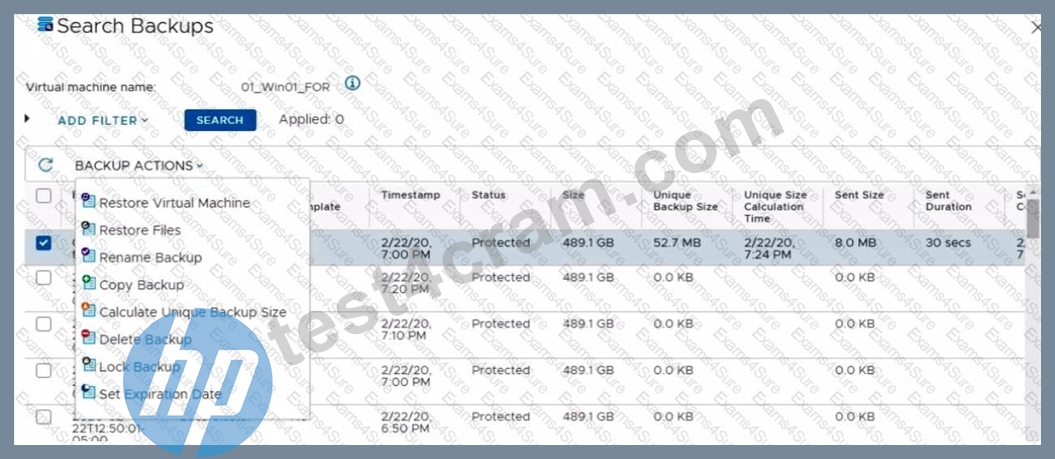
Answer:
Explanation: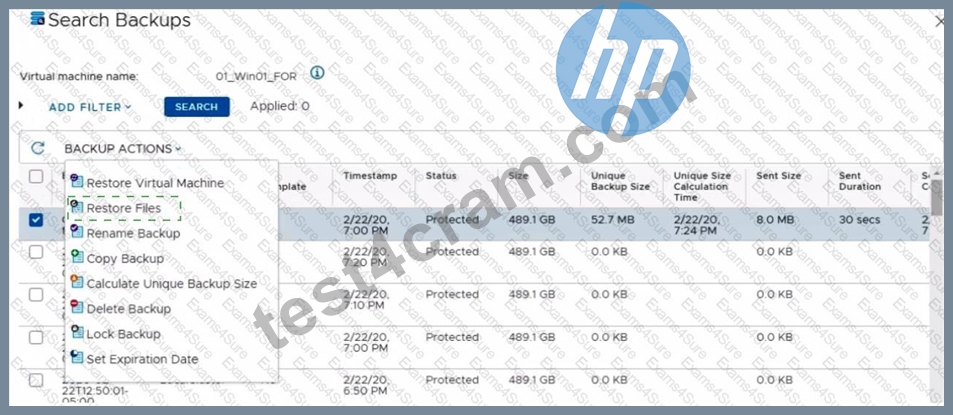
Explanation:
To use this option, you need to select the backup from which you want to restore the files, then click Backup Actions > Restore Files. You will be prompted to enter the following information:
The name of the virtual machine where you want to restore the files
The path of the folder where you want to restore the files
The path of the folder that you want to restore from the backup
The credentials of the virtual machine where you want to restore the files After you enter the required information, click OK to start the restore process3.
HPE SimpliVity Hyperconverged Infrastructure for VMware vSphere 3.7.10 Administration Guide, page 97 HPE SimpliVity Hyperconverged Infrastructure for VMware vSphere 3.7.10 Best Practices Guide, page
20
Restore files from a backup - techhub.hpe.com
NEW QUESTION # 31
......
HPE2-K45 exam consists of 60 multiple-choice questions that need to be answered within 90 minutes. HPE2-K45 exam questions are designed to test the candidate's understanding of HPE SimpliVity and its features. HPE2-K45 exam also evaluates the candidate's ability to apply their knowledge in real-world scenarios.
Verified Pass HPE2-K45 Exam in First Attempt Guaranteed: https://www.test4cram.com/HPE2-K45_real-exam-dumps.html
HP HPE2-K45 Real Exam Questions Guaranteed Updated Dump from Test4Cram: https://drive.google.com/open?id=1Gsfdsxa8b0tFuhH4bJtxxni_SAXH7HEr