

2025 Valid FCP_GCS_AD-7.6 FREE EXAM DUMPS QUESTIONS & ANSWERS
Free FCP_GCS_AD-7.6 Exam Braindumps Fortinet Pratice Exam
NEW QUESTION # 22
Which architecture inspection type in Google Cloud is most closely associated with Google Cloud Interconnect?
- A. Hybrid cloud inspection
- B. Inbound north-south traffic inspection
- C. Outbound north-south traffic inspection
- D. East-west traffic inspection
Answer: A
Explanation:
Google Cloud Interconnect connects on-premises networks with Google Cloud, enabling hybrid cloud environments. Inspection related to this connectivity focuses on hybrid cloud traffic flows.
NEW QUESTION # 23
You are tasked with deploying a load balancer in Google Cloud that does not terminate sessions arriving from outside the VPC and that forwards traffic to the organization's internal web servers.
Which load balancer type should you deploy?
- A. Internal passthrough load balancer
- B. External application load balancer
- C. Proxy network load balancer
- D. External passthrough load balancer
Answer: D
Explanation:
An external passthrough load balancer forwards traffic without terminating sessions, preserving the original client connection, which is ideal for forwarding traffic directly to internal web servers.
NEW QUESTION # 24
You have been tasked with destroying all resources relating to a recent active-active high-availability (HA) FGSP Terraform deployment in Google Cloud.
What steps do you have to take to ensure a successful deletion? (Choose two.)
- A. Use the command terraform plan before destroying the Terraform template.
- B. Delete all dependencies to resources relating to the Terraform template.
- C. Delete all resources manually because active-active HA clusters cannot be destroyed using Terraform.
- D. Use the command terraform destroy to delete all resources deployed by the Terraform template.
Answer: B,D
Explanation:
Removing dependencies prevents resource conflicts during deletion.
terraform destroy is the correct command to cleanly and completely remove all resources created by the Terraform deployment.
NEW QUESTION # 25
An administrator has been tasked with modifying their organization's existing active-passive high-availability (HA) FortiGate cluster and turn it into an active-active HA cluster.
Which two behavior changes will the administrator see in the cluster after the change? (Choose two.)
- A. There is no longer a need to reserve a dedicated port for HA communications.
- B. The cluster no longer act as a single logical instance.
- C. The configuration will no longer be synchronized between cluster members.
- D. The sessions will no longer be synchronized between cluster members.
Answer: A,B
Explanation:
Active-active HA does not require a dedicated HA communication port as each member handles traffic independently.
In active-active mode, cluster members operate more independently and do not present as a single logical device like in active-passive mode.
NEW QUESTION # 26
For what three reasons must you deploy a set of Google Cloud passthrough network load balancers for an active-passive high-availability (HA) FortiGate cluster instead of a set of Google Cloud proxy network load balancers? (Choose three.)
- A. Passthrough network load balancers can forward all protocols.
- B. Passthrough network load balancers support health checks.
- C. Passthrough network load balancers terminate SSL connections.
- D. Passthrough network load balancers rely on API calls from FortiGate devices during HA failovers.
- E. Passthrough network load balancers offer the highest throughput.
Answer: A,B,E
Explanation:
Passthrough load balancers support health checks to monitor backend health for failover.
They can forward all protocols, not limited to HTTP/HTTPS like proxy load balancers.
Passthrough load balancers provide higher throughput because they don't terminate sessions.
NEW QUESTION # 27
An organization has decided to deploy an active-active high-availability cluster in Google Cloud.
Which three load balancing features are critical to the successful deployment of the cluster? (Choose three.)
- A. The health check used by the internal and the external passthrough network load balancer
- B. The L3_DEFAULT protocol in the forwarding rule of the internal passthrough network load balancer
- C. The session termination of the external passthrough network load balancer
- D. The symmetric hashing of the internal passthrough network load balancer
- E. The forwarding rule for the internal passthrough network load balancer as the next hot for custom routes
Answer: A,D,E
Explanation:
Health checks ensure load balancers route traffic only to healthy cluster members.
Forwarding rules act as next hops in routing, directing traffic appropriately within the HA cluster.
Symmetric hashing ensures consistent and balanced traffic distribution across cluster members, critical for active-active deployments.
NEW QUESTION # 28
Your organization is deciding between deploying FortiGate active-passive high-availability (HA) in Google Cloud using either the software-defined network (SDN) connector or load balancers.
What two reasons should your organization choose the SDN connector over the load balancer deployment?
(Choose two.)
- A. Failovers are faster because of to API calls.
- B. Cost is lower.
- C. The SDN connector supports multizone failover.
- D. There isess administrative overhead.
Answer: B,D
Explanation:
Using the SDN connector avoids additional load balancer costs, making it more cost-effective.
The SDN connector enables multizone failover by directly managing network routing, which load balancers do not inherently support.
NEW QUESTION # 29
Refer to the exhibit.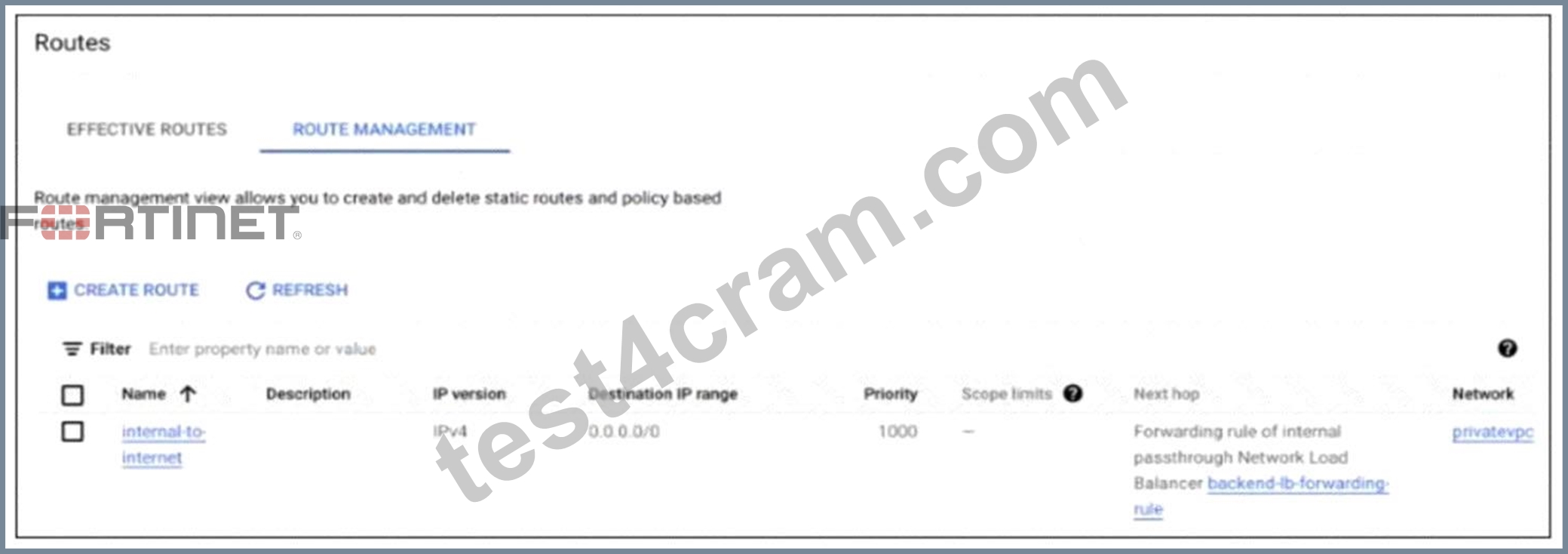
Which three conclusions can you draw from the Google Cloud custom route? (Choose three.)
- A. At least one instance group was created.
- B. The next hop must be updates manually in the custom route if the current next hop goes down.
- C. A health check was created.
- D. A group-based passthrough network load balancer was created.
- E. Atarget pool-based passthrough network load balancer was created.
Answer: A,B,C
Explanation:
The route's next hop is a forwarding rule for a backend service, which indicates a group-based passthrough load balancer.
Group-based load balancers require health checks to monitor instance health.
Backend services attach to instance groups to distribute traffic, so at least one instance group exists.
NEW QUESTION # 30
A cloud administrator has been receiving reports of slow response times from users accessing their organization's web application, which is protected by FortiWeb Cloud.
Which two steps can be taken to potentially alleviate the problem? (Choose two.)
- A. Adding additional passthrough load balancers.
- B. Enabling the content delivery network (CDN).
- C. Deploying FortiWeb Cloud in the same region where the web application is hosted.
- D. Changing the DNS records to point to the web application.
Answer: B,C
Explanation:
Deploying FortiWeb Cloud closer to the web application reduces latency and improves response times.
Enabling CDN caches content closer to users, reducing load times and speeding up content delivery.
NEW QUESTION # 31
An administrator is tasked to deploy two FortiGate devices in two different zoned to achieve geographical redundancy.
Which two architectural considerations must the administrator address? (Choose two.)
- A. The FortiGate devices must not be deployed in the same VPC.
- B. The FortiGate devices can be deployed in the same subnet.
- C. The FortiGate devices cannot be assigned the second IP address in the subnets that they are deployed in.
- D. The FortiGate devices must be deployed in two different regions.
Answer: C,D
Explanation:
Deploying FortiGate devices in different regions ensures geographic redundancy.
The second IP address in a subnet is reserved for the default gateway in Google Cloud, so FortiGate devices cannot use that IP.
NEW QUESTION # 32
An organization decided to decommission a deployed FortiWeb instance on Google Cloud.
What is the most efficient way to delete the FortiWeb instance and all of its dependent resources?
- A. Delete the FortiWeb instance manually in the Compute Engine portal.
- B. Visit Google Cloud Marketplace and unsubscribe from FortiWeb pay-as-you-go.
- C. Use Google Cloud Solutions to delete the FortiWeb deployment.
- D. Use Google Cloud Deployment Manager to delete the FortiWeb deployment.
Answer: D
Explanation:
Google Cloud Deployment Manager manages the lifecycle of deployments and their dependent resources, enabling efficient and clean deletion of FortiWeb instances and all associated resources in one operation.
NEW QUESTION # 33
Google Cloud network services offer vast functionality and inter-connectivity between the cloud and on- premises networks.
Which three additional functions does FortiGate offer when deployed in Google Cloud to complement the native services offered by Google Cloud? (Choose three.)
- A. Web filtering
- B. Secure SD-WAN with application visibility
- C. SSL VPN
- D. SSL inspection
- E. OSPF over IPSec
Answer: B,C,D
Explanation:
FortiGate provides SSL VPN capabilities for secure remote access.
It offers SSL inspection to decrypt and inspect encrypted traffic for threats.
FortiGate supports Secure SD-WAN with deep application visibility and control, enhancing network performance and security beyond native Google Cloud services.
NEW QUESTION # 34
Your organization has decided to deploy a high-availability (HA) cluster. One kye requirement of the deployment is to support configuration synchronization.
Which three deployment types should be considered? (Choose three.)
- A. Active-passive HA using FGSP
- B. Active-active HA using auto scaling
- C. Active-passive HA using passthrough load balancers
- D. Active-passive HA using software-defined networking (SDN)
Answer: A,C,D
Explanation:
These three deployment types support configuration synchronization between HA cluster members, which is critical for maintaining consistent state and seamless failover.
NEW QUESTION # 35
Google Cloud network services offer vast functionality and inter-connectivity between the cloud and on- premises networks.
Which three additional functions does FortiGate offer when deployed in Google Cloud to complement the native services offered by Google Cloud? (Choose three.)
- A. Web filtering
- B. Secure SD-WAN with application visibility
- C. SSL VPN
- D. SSL inspection
- E. OSPF over IPSec
Answer: B,C,D
Explanation:
FortiGate provides SSL VPN capabilities for secure remote access.
It offers SSL inspection to decrypt and inspect encrypted traffic for threats.
FortiGate supports Secure SD-WAN with deep application visibility and control, enhancing network performance and security beyond native Google Cloud services.
NEW QUESTION # 36
What are the two responsibilities of a Google Cloud customer in terms of security? (Choose two.)
- A. The Google Cloud customer is responsible for securing operating systems and applications.
- B. The Google Cloud customer is responsible for securing the computing resources.
- C. The Google Cloud customer is responsible for securing network traffic.
- D. The Google Cloud customer is responsible for securing cloud storage infrastructure.
Answer: A,C
Explanation:
Customers manage security for their data, applications, operating systems, and network configurations, while Google secures the underlying cloud infrastructure.
NEW QUESTION # 37
......
Prepare For Realistic FCP_GCS_AD-7.6 Dumps PDF - 100% Passing Guarantee: https://www.test4cram.com/FCP_GCS_AD-7.6_real-exam-dumps.html
Practice Test for FCP_GCS_AD-7.6 Certification Real 2025 Mock Exam: https://drive.google.com/open?id=1l7pBcBQgWBVevOthxKbWzn5qQg21NY5F